Discover the destination Pula
Arena, Pula (Pula, Istria)
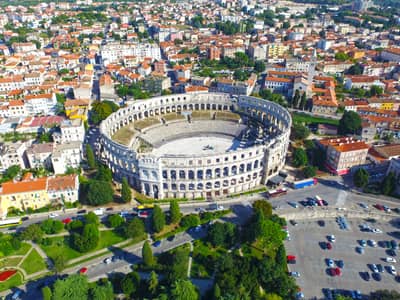
Popularly called the Arena of Pula, it was bulit in the 1st century AD during the reign of Emperor Vespasian and it became the ancient monument in the center of Pula. 3000 years ago it hosted the popular gladiator fights which took place in the central flat area called the arena, but today many summer performances take place in the same place where gladiator had fought in the Roman time. It is the 6th largest ancient amphitheater in the world. Arena info
Arch of the Sergii – Golden Gate (Pula, Istria)
Called Twin Gates because of the two arches through which you enter the inner yard, they were built between the 2nd and 3rd centuries and today they guide to the Archeological Museum and the Castle.In the ancient and medieval times the city was surrounded by the city walls and people had ten gates to enter in the center. The walls had become old and unnecessary so they were destroyed at the beginning of the 19th century. Arch of the Sergii – Golden Gate Info
The Twin Gates (Pula, Istria)
Called Twin Gates because of the two arches through which you enter the inner yard, they were built between the 2nd and 3rd centuries and today they guide to the Archeological Museum and the Castle.In the ancient and medieval times the city was surrounded by the city walls and people had ten gates to enter in the center. The walls had become old and unnecessary so they were destroyed at the beginning of the 19th century. Twin Gates Info
Forum (Pula, Istria)
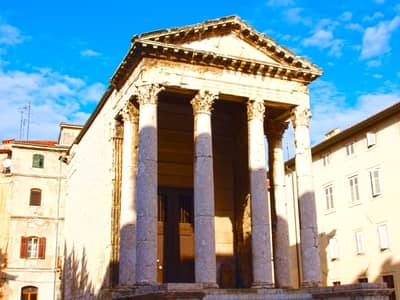
Situated in the western part of Pula, Forum is the main square. During the Roman time it was the nucleous of the city and its religious, administrative, legislative and commercial center. On the northern part of the Forum stood two twin temples and a central one dedicated to Jupiter, Juno and Minerva. Today only the Temple of Augustus has been preserved. Anyway even today the Forum remains the administrative and legislative center of Pula. In the summer season it"s a place where many cultural events take place. Forum Info
National park Brioni (Brijuni) (Pula, Istria)
The only national park in Istria. Brijuni has 14 islands which present a unique play of nature that brings together remarkable animal species and rare flora.An excursion to Veli Brijun, the largest island with a guide include sightseeing of the island natural beauty, safary park, walkway of the Dinosaurs, where numerous traces can be found of these fascinating, extinct animals. Brioni info
Amphitheatre (Arena)
The most famous and important monument, the starting and ending point of every sightseeing tour is the Amphitheater, popularly called the Arena of Pula, which was once the site of gladiator fights. It was built in the 1st century AD during the reign of Emperor Vespasian, at the same time as the magnificent Colosseum in Rome.
The ground plan is elliptical, the longer axis measuring about 130 m and the shorter one about 100 m. Gladiator fights took place in the central flat area called the arena, while the spectators could sit on the stone tiers or stand in the gallery. It is believed that the Amphitheater could seat about 20,000 spectators. Local limestone was used for its construction. In the Middle Ages it was the site of knights tournaments and fairs. Today it is the venue for summer performances - the Film Festival, Opera Season, Equestrian Festival, concerts, ... which can seat about 5,000 spectators. The underground passages, once used by the gladiators, nowadays host a regular exhibition of viticulture and olive growing in Istria in ancient times. The exhibits include reconstructions of machines once used for the production of olive oil and wine (mills, presses, vessels) and amphorae used for storing and transporting olive oil and wine. The Amphitheater is situated outside the old city walls because of its size and geographical configuration. The road that leads to the center was constructed during Emperor Vespasian, after whom it was named - Via Flavia. Even today it represents one of the main city roads.
Forum
The main square of classical and medieval Pula is situated at the foot of the central hill, in the western part of the city close to the sea. The coast where the Forum was constructed in the 1st century BC had to be filled up to gain a larger area.
The Forum was the nucleus of city life, its religious, administrative, legislative and commercial center. On the northern part of the Forum stood two twin temples and a central one dedicated to Jupiter, Juno and Minerva. Today only the Temple of Augustus has been fully preserved while of the second temple only the back wall, built into the Communal Palace in the 13th century, is visible. Ancient remains of the Forum have been found during the construction of new buildings, the latest ones being "Agrippina and her time" (1st century AD). The remains have been partly restored and are now exhibited in the bank built on the site. Even today the Forum is the administrative and legislative center of the city. During the summer months it is the venue for numerous cultural events.
Communal Palace
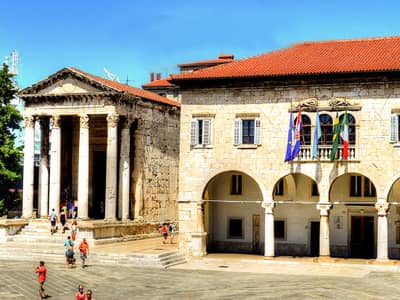
At the time when Pula was a free municipality, a palace was erected in the Forum – the seat of the municipal self-government. During the Venetian rule it was the seat of the duke and provveditore, and until the present has remained the seat of the mayor.
Additions over the centuries (from the 10th -16th centuries) led to a building that in an exceptional way combines architectural styles from the Romanesque until the Renaissance. The inscription built in the facade, which was restored in the 16th century, dates the construction of the Communal Palace to 1296. The year probably refers to the first greater reconstruction and addition, because this was surely the seat of the municipal government even earlier. Earlier phases of the development of the Communal Palace in terms of its construction can best be seen on the eastern wall where Romanesque and Gothic styles intertwine. Sculptures of Telamon and Siren in the corners closed by Renaissance columns, and Baroque windows are the latest alterations of the outer appearance of the Communal Palace: neglect and negligence have left considerable traces on the building that has recently been radically restored.
Gate of Hercules
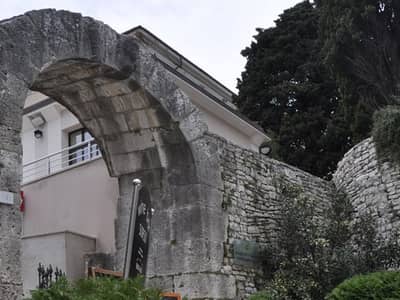
It stands between two, most probably medieval towers, of simple construction built of uncarved stone blocks. At the top of the damaged arch, although hardly recognizable, is a carving of the head of Hercules and his club.
Close to the club is a damaged inscription, most interesting in the historical context since it contains the names of two Roman officials, Lucius Calpurnius Piso and Gaius Cassius Longinus to whom the Roman Senate had entrusted the duty to found a Roman colony at the site of today’s Pula. Thus, between 47 and 44 BC Pula was founded as a settlement with urban features. Since the upper circular street passed though this gate, the axis of communication was obliquely placed with respect to the direction of the city walls.
Castle
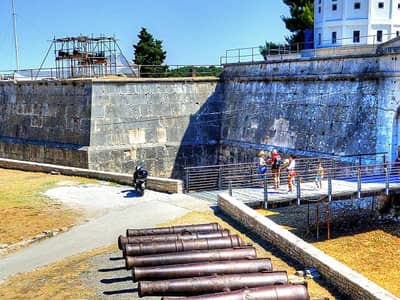
From the upper circular street one of the perpendicular paths leads to the top of the central hill of the city where a star-shaped castle with four bastions was built in 1630.
Wishing to protect the city and its harbor, because of it great significance in maritime trade in the North Adriatic, the Venetians commissioned the building of the Castle from the French military architect Antoine de Ville. This was most probably the site of an earlier fortress dating from the pre-Roman and Roman period. The Histrian hill-fort was primarily built for defensive purposes, whereas in the Roman period a small military garrison was stationed here. Today the Castle houses the Historical Museum of Istria.
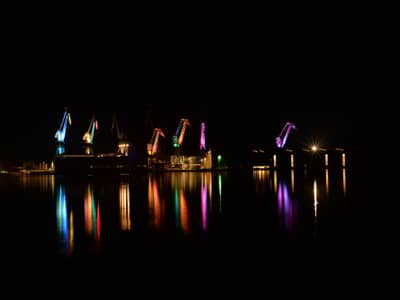
Lighting Giants
Triumphal Arch of the Sergi – Golden Gate
The “Golden Gate” was erected between the years 29 and 27 BC by the Sergi family, in honor of three members of the family who held important positions in Pula at that time. This triumphal arch leaned against the city gate Porta Aurea thus called because of its richly ornamented arch or gilded elements.
The gate and wall were pulled down in the beginning of the 19th century as a result of the city expansion outside the city walls. The Arch was constructed in Corinthian style with strong Hellenistic and Asia Minor influences both in the method and ornaments. As the eastern side was not visible it has remained for the most part uncarved, while the western, town side is richly decorated. Today numerous cultural performances, theatrical and musical, are held on the square next to the Arch. The adjacent street is a shopping area.
_thumb_400x300.jpg)
07
Ambrela
Beach Ambrela is placed right at the entrance into the tourist zone Verudela. Because of its cleanliness and exceptional water quality, it has been awarded the Blue Flag. It attracts especially families with children beacause it has an accesible entrance into the sea . On the beach you can rent deck- chairs and parasols, and there can be found cabins and showers. It’s possible to rent different water and beach sports equipment.The lifeguard service oberves swimmers throughout the day in order to keep all the simmers safe. In the sea has been set the swimmers sea border line. A few meters from the beach, you can find shade as well as two snack bars where you can always refresh.
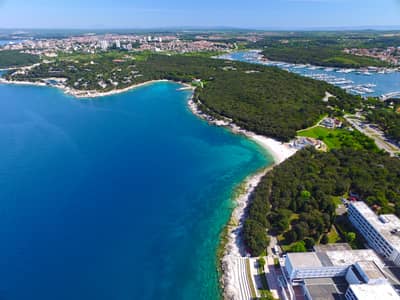
Brioni
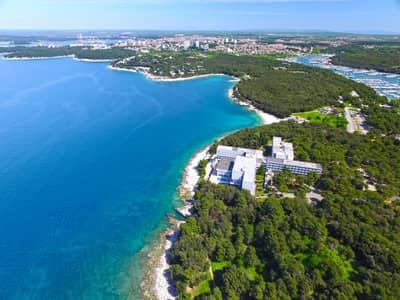
Gortanova Uvala
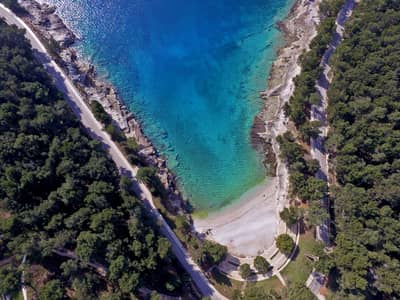
Hawaii
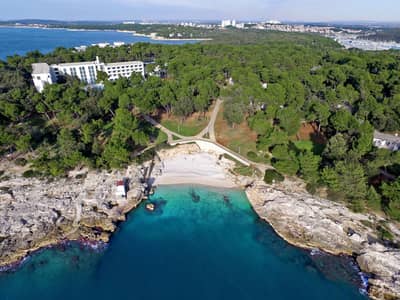
Histria
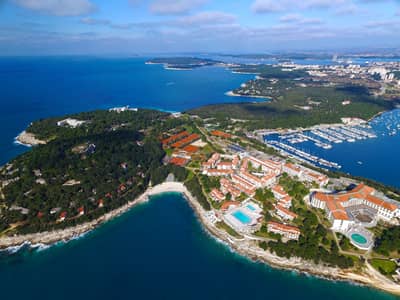
Puntizela
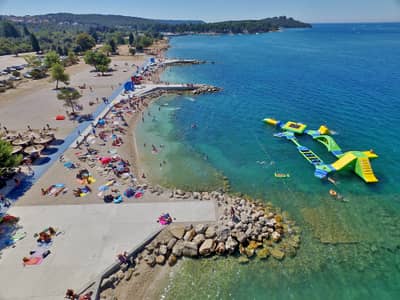
Stoja
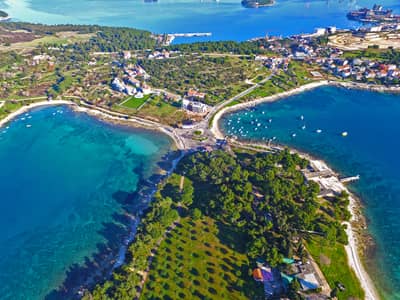
Valkane
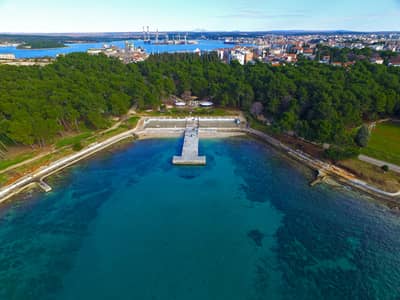
Beach Vile Stinjan, Travel Guide for holidays in Pula, Istria
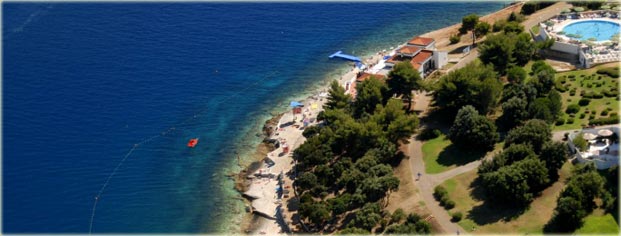
In the southwestern part of Istria, 5km from Pula, in a beautiful bay lies the little place called Štinjan. This is an ideal vacation destination for families because of its beautiful nature and picturesque beaches, Vile is one of the most fascianting beaches in the bay, covered with tiny pebbles and surrounded by rich vegetation. Besides sunbathing and swimming in the clear sea, you can get involved into various sport activities. There is a sandy volleyball field as well as a wide range of water sport activities. The equipment can be rented there, as well as deckchairs. The landscape is fascinating and pleasant for long walks or bike riding. There is also a famous diving centre. Not far from the beach you can see a restaurant, from which you have a beautiful view over the Brijuni Islands while enjoying a wide range of food and beverage offer.
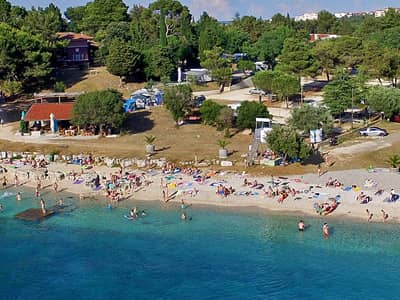
09
Church and Monastery of St. Francis
On the slope of the hill between the Forum and the upper circular street, lies the monastic complex dedicated to St. Francis of Assisi, built in the 14th century at the site of a previous cultic edifice.
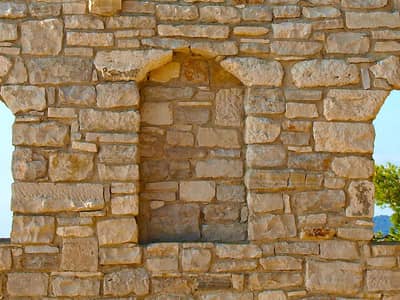
The Franciscan community was first recorded in Pula in the 13th century. The church was built in 1314 in the late Romanesque style with Gothic ornaments, as a firm and simple building of the preaching Franciscan order. The finely cut stone blocks used for building the walls speak of the skilful masters who took part in the construction.
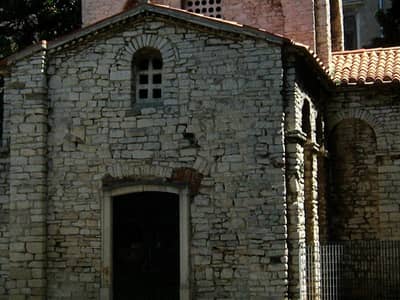
Church of St. Maria Formosa
It is one of the two chapels built in the 6th century as part of a large Benedictine abbey demolished in the 16th century. The floor and walls were decorated with mosaics, some of which are now in the Archaeological Museum of Istria.
It was built in the style of Ravenna churches, the only difference being the use of stone instead of brick. Due to its dimensions, method of construction and good state of preservation, the Chapel represents an extraordinary architectural masterpiece of its time.
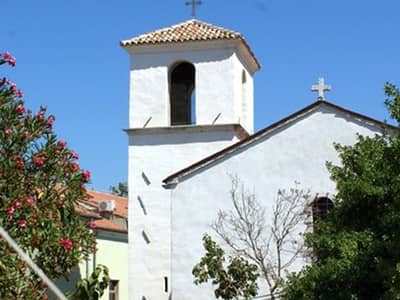
Cathedral of the Assumption of the Blessed Virgin Mary
Within the city, along the main street that from Flavia Street leads to the Forum, stands the Cathedral of Pula. It was built at the site where Christians gathered already in the time of their persecution (until the 4th century).
With the ages it grew larger and assumed its present-day shape in the 5th century. It had an elongated oblong shape whose interior was divided by two rows of columns. The area around the altar was in the north, defined by a semi-circular podium with stalls for the clergy. In front of the altar area, behind it and around the very altar, still lie fragments of the floor mosaic from the 5th – 6th centuries, with memorial inscriptions of worshippers who paid for the decoration of the specific surface. The oldest preserved remains of the church wall from the beginning of the 4th century can be seen from outside: the lower part of the rear wall belongs to this period. Due to a fire in 1242 the church underwent reconstruction on several occasions. While the upper windows of the nave were built in the early Christian period, the windows of the aisles bear typical Gothic traits. In front of the church, a baptistery, cross-shaped by ground plan, was built in the 5th century. It was destroyed in 1885. In the beginning of the 16th century a new late Renaissance facade was built, and in front of the church, a belfry was erected in the second half of the 17th century (1671-1707). Stone blocks from the Amphitheater were used for its construction. At the site of the present-day park, east of the Cathedral, until 1657 stood the church dedicated to the patron saint of Pula, St. Thomas. This church too, was built in the 5th century and such twin ecclesiastical complexes were no novelty in Istria (Nesactium, Poreč). After its destruction in the Middle Ages, St. Thomas’ Church was not reconstructed; its surface remains were last evident back in 1812.
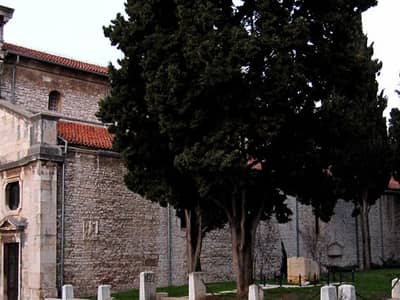
Orthodox Church of St. Nicholas
Built in the second half of the 6th century, with a typical Ravenna-like polygonal apse, the church was dedicated to the Blessed Virgin Mary.
After its radical reconstruction around 1200, it was assigned to the Greek Orthodox community in Pula in 1583 formed by immigrants from Cyprus and Nauplion: Today it belongs to the Serbian Orthodox church. It keeps the iconostasis of the Greek master Tomios Batos from the 18th century, valuable icons and other objects.
04

More about Pula
find out more
Pula History
Located on the southern part of Istria, Pula is the largest city and the major port of Istrian peninsula.It was founded more than 3000 thousand years ago and nowadays it is one of the most famous tourist centers and cultural sights. The Roman conquest of the peninsula gave a particular importance to the city of Pula since the Roman touch can be seen everywhere in the old city center.
Many of the most beautiful Roman buildings were preserved for a lot of centuries and walking on the street you can admire the August Temple, Triumphal Arch of the Sergi family also known as Golden Gate, The Cathedral of the Extol of the Blessed Virgin Mary, Temples and Basilicas on the Forum, Communal Palace on the Forum, Roman Walls, Roman Gates, Roman Theater and the most important and beautiful one: The Amphitheater known as a Colosseum from the 2nd century.
Under Roman occupation, up to the 5th century, Pula and the surrounding areas developed greatly. Afterwards, in the 6th Century the city came under Byzantine rule and at the end of the 8th Century there came a period of Frankish rule. In the middle ages Pula was under the control of Venice . During the Venetian period the region experienced a loss of its population and was affected by plague and many of the classical architecture of the city was ruined.
When in 1797 the Venetian rule declined, Pula fell to the Austrian empire and became, after 1866, the main base of the Austrian Imperial Navy. The city flourished , the shipping industry developed and during the whole Austrian empire Pula was their major port, the naval force and became the fortressed city and one of the best protected cities in the Europe. Shipyard bulit the ships in the arsenal and anchored a lot of other ships in the port. Up to nowadays, Pula is one of the largest ports and shipyards in the country and is still developing its main economy. In the last decades Pula has become one of the main tourist destinations and it’s still growing and developing. Nowadays Pula is a welcoming city offering genuine hospitality to all visitors.
Pula Culture
The city Pula is a treasure itself. A walk through the streets and piazzas will help you to experience the historical stories written in every monument and every stone. It is said in Pula that everystone has its own story to tell and re-tell. In order to get you closer to the history you can visit some of the museums in Pula: Historical and Maritime Museum of Istria, Archaeological Museum of Istria and next to it you can find the underground galleries, the Museum of Contemporary Art of Istria, the gallery Sacred Hearts and many others.
Especially during the summer months Pula offers a great amount of cultural activity such as The Film Festival which is held in the Roman Amphitheater, the Art & Music Festival , The International Youth Theatre Festival , the Ulysses Theater with its numerous plays on the Brijuni Minor, The International festival of alternative theatre, the Seasplash festival. The City has many galleries as well like: Cvajner, City Gallery, Youth Club, Milotic, MMC Luka, Nemes, Okvir (Framework), Old Town, Vincent from Kastav and many more.
Pula – Things to do
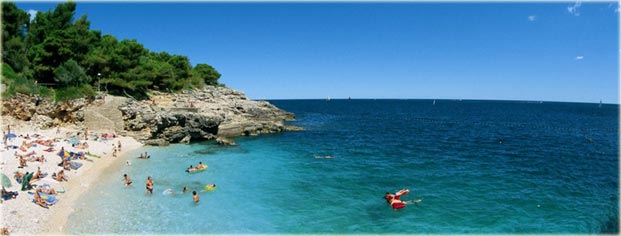
Besides the fact that the city Pula is the major Istrian town, it has many places for amusement and fun. It is a suitbale city for all age groups beacuse it offers different kind of entertainment. During the day you can enjoy the different sports and recreational and adrenalin activities such as: diving, carting, hiking, walking, cycling, fitness, wellness, windsurfing, sailing, basket ball, tennis, beach volley ball, panoramic flights, free climbing etc. For guests who are not so interested in the sport, Pula offers amazing excursions to the National Park Brijuni, Island Veruda known as the Monk’s Island which has a Camp site, and other neighbor islands. It has numerous restaurants, taverns, pizzerias, coffee bars, Internet corners and similar places. During the night you can take part in the Pula night life in the many discobars, beach bars and night bars. Many of those are: Aruba, Cabahia, Monte Serpente, LMC Club, Pietas Iulia, Podroom, Rock Caffe, Rock Club Uljanik, the Cube, Zen and many others.
Pula – Entertainments and events
Especially during the summer season you can enjoy a rich repertoire of events in Pula. There is everyday something to do or somewhere to go. In the city center you can immerse in the atmosphere of the squares and streets of this city in a variety of cafe-bars and attend many events which take place in the little squares among the streets. If you intend to party till the early morning hours, visit one of the numerous discotheques. Here is a list of some of the events held every year in Pula:
Pula night – along the streets of our city” – The program takes place in six locations, stretching from the Forum to the Giardin.
Istrian Hand Made – Fair original Istrian souvenirs and handicrafts.
Istria gourmet – Istrian gourmet products fair
Arena Music Nights – variuos music concerts which take place in the colloseum
Days of antiquity – take place on the streets of Pula and it’s a revival of the Roman time
Evening of folklore – experience the old tradition and the old fashion
Salsa Party – dance with the salsa instructor right in the middle of the anciest square in Pula
Pula – Service Information
Regional Number Code 052
Police Department 192;
Fire Department 193;
Emergency 194;
Bus Station 502-997;
Airport 550-900;
Ambulance 376-000;
Harbour/Ferry 222-037;
Tourist Office 212-987;
Railway 541-733;
General Information 981.
Pula – How to reach us
You can reach Pula from many directions and with different transport.:
By bus – the bus station connects Pula and the surroundings and other Croatian location as well;
By train – the train station in Pula connects Pula with the capital Zagreb and with the Slovenian capital Ljubljana;
By boat – to the major ports or by personal boat to the smaller ports or marinas in the city;
By plane – the Pula airport has a connection with the capital Zagreb and many other location in Europe.
By car – when coming from the north: Ljubljana – Črni Kal – border crossing Požane – Buzet – Pula or Villach – Udine – Trst – Koper – border crossing Kaštel or Plovanija – Pula
when coming arriving from the east: Zagreb – Rijeka – Učka tunnel – Pula