Discover the destination Fažana
Fazana (Pula, Istria)
Fazana is a small fishing town, settled near the biggest town in Istria, Pula, and the main port to the National Park Brijuni. It is fascinating town, whose inhabitants still safeguard the traditional activities and manifestations which gives the touch of the past times characterized with the fishing and gourmet parties. There was founded the Fishing Academy “Sardela” where you can learn how to fish the sardine fish, and how to make good meals with them. Fažana is a place where is kept a traditional way of life, and the natural fruits are well appreciated.
Amphitheatre (Arena)
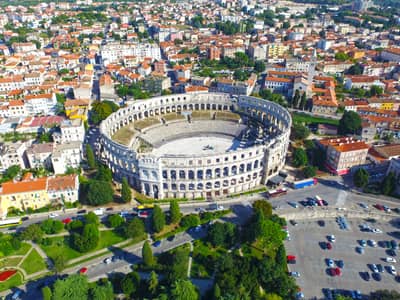
The most famous and important monument, the starting and ending point of every sightseeing tour is the Amphitheater, popularly called the Arena of Pula, which was once the site of gladiator fights. It was built in the 1st century AD during the reign of Emperor Vespasian, at the same time as the magnificent Colosseum in Rome.
The ground plan is elliptical, the longer axis measuring about 130 m and the shorter one about 100 m. Gladiator fights took place in the central flat area called the arena, while the spectators could sit on the stone tiers or stand in the gallery. It is believed that the Amphitheater could seat about 20,000 spectators. Local limestone was used for its construction. In the Middle Ages it was the site of knights tournaments and fairs. Today it is the venue for summer performances - the Film Festival, Opera Season, Equestrian Festival, concerts, ... which can seat about 5,000 spectators. The underground passages, once used by the gladiators, nowadays host a regular exhibition of viticulture and olive growing in Istria in ancient times. The exhibits include reconstructions of machines once used for the production of olive oil and wine (mills, presses, vessels) and amphorae used for storing and transporting olive oil and wine. The Amphitheater is situated outside the old city walls because of its size and geographical configuration. The road that leads to the center was constructed during Emperor Vespasian, after whom it was named - Via Flavia. Even today it represents one of the main city roads.
Forum
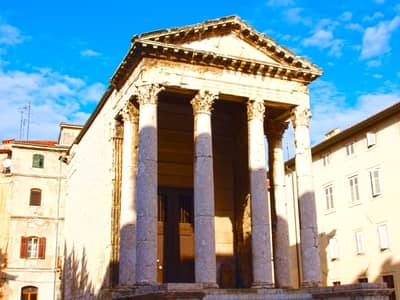
The main square of classical and medieval Pula is situated at the foot of the central hill, in the western part of the city close to the sea. The coast where the Forum was constructed in the 1st century BC had to be filled up to gain a larger area.
The Forum was the nucleus of city life, its religious, administrative, legislative and commercial center. On the northern part of the Forum stood two twin temples and a central one dedicated to Jupiter, Juno and Minerva. Today only the Temple of Augustus has been fully preserved while of the second temple only the back wall, built into the Communal Palace in the 13th century, is visible. Ancient remains of the Forum have been found during the construction of new buildings, the latest ones being "Agrippina and her time" (1st century AD). The remains have been partly restored and are now exhibited in the bank built on the site. Even today the Forum is the administrative and legislative center of the city. During the summer months it is the venue for numerous cultural events.
Communal Palace
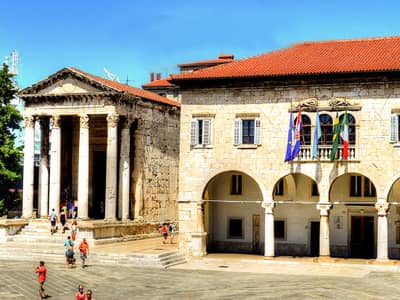
At the time when Pula was a free municipality, a palace was erected in the Forum – the seat of the municipal self-government. During the Venetian rule it was the seat of the duke and provveditore, and until the present has remained the seat of the mayor.
Additions over the centuries (from the 10th -16th centuries) led to a building that in an exceptional way combines architectural styles from the Romanesque until the Renaissance. The inscription built in the facade, which was restored in the 16th century, dates the construction of the Communal Palace to 1296. The year probably refers to the first greater reconstruction and addition, because this was surely the seat of the municipal government even earlier. Earlier phases of the development of the Communal Palace in terms of its construction can best be seen on the eastern wall where Romanesque and Gothic styles intertwine. Sculptures of Telamon and Siren in the corners closed by Renaissance columns, and Baroque windows are the latest alterations of the outer appearance of the Communal Palace: neglect and negligence have left considerable traces on the building that has recently been radically restored.
Gate of Hercules
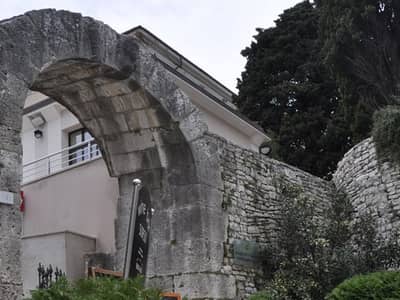
It stands between two, most probably medieval towers, of simple construction built of uncarved stone blocks. At the top of the damaged arch, although hardly recognizable, is a carving of the head of Hercules and his club.
Close to the club is a damaged inscription, most interesting in the historical context since it contains the names of two Roman officials, Lucius Calpurnius Piso and Gaius Cassius Longinus to whom the Roman Senate had entrusted the duty to found a Roman colony at the site of today’s Pula. Thus, between 47 and 44 BC Pula was founded as a settlement with urban features. Since the upper circular street passed though this gate, the axis of communication was obliquely placed with respect to the direction of the city walls.
Castle
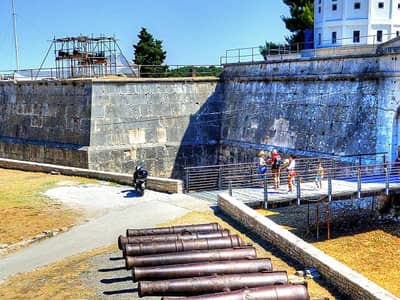
From the upper circular street one of the perpendicular paths leads to the top of the central hill of the city where a star-shaped castle with four bastions was built in 1630.
Wishing to protect the city and its harbor, because of it great significance in maritime trade in the North Adriatic, the Venetians commissioned the building of the Castle from the French military architect Antoine de Ville. This was most probably the site of an earlier fortress dating from the pre-Roman and Roman period. The Histrian hill-fort was primarily built for defensive purposes, whereas in the Roman period a small military garrison was stationed here. Today the Castle houses the Historical Museum of Istria.
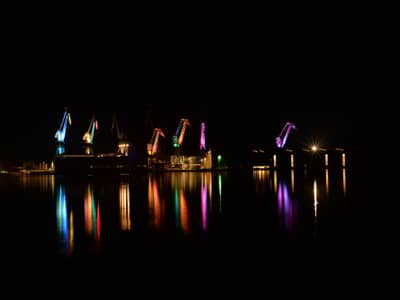
Lighting Giants
Triumphal Arch of the Sergi – Golden Gate
The “Golden Gate” was erected between the years 29 and 27 BC by the Sergi family, in honor of three members of the family who held important positions in Pula at that time. This triumphal arch leaned against the city gate Porta Aurea thus called because of its richly ornamented arch or gilded elements.
The gate and wall were pulled down in the beginning of the 19th century as a result of the city expansion outside the city walls. The Arch was constructed in Corinthian style with strong Hellenistic and Asia Minor influences both in the method and ornaments. As the eastern side was not visible it has remained for the most part uncarved, while the western, town side is richly decorated. Today numerous cultural performances, theatrical and musical, are held on the square next to the Arch. The adjacent street is a shopping area.
_thumb_400x300.jpg)
07
Ambrela
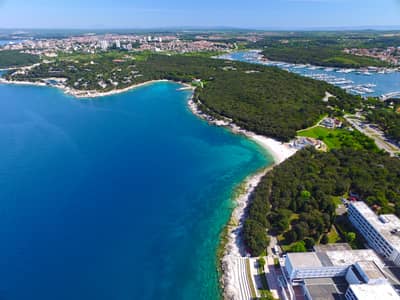
Beach Ambrela is placed right at the entrance into the tourist zone Verudela. Because of its cleanliness and exceptional water quality, it has been awarded the Blue Flag. It attracts especially families with children beacause it has an accesible entrance into the sea . On the beach you can rent deck- chairs and parasols, and there can be found cabins and showers. It’s possible to rent different water and beach sports equipment.The lifeguard service oberves swimmers throughout the day in order to keep all the simmers safe. In the sea has been set the swimmers sea border line. A few meters from the beach, you can find shade as well as two snack bars where you can always refresh.
Brioni
Gortanova Uvala
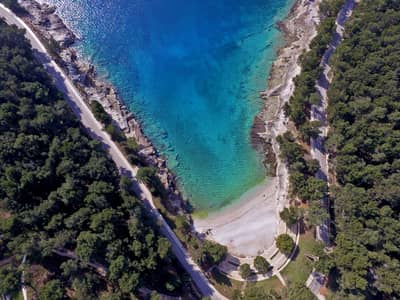
Hawaii
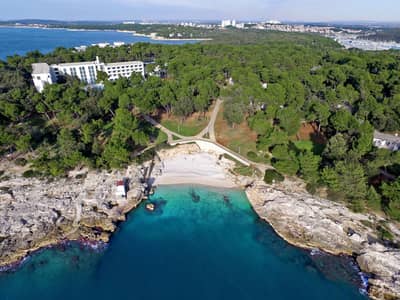
Histria
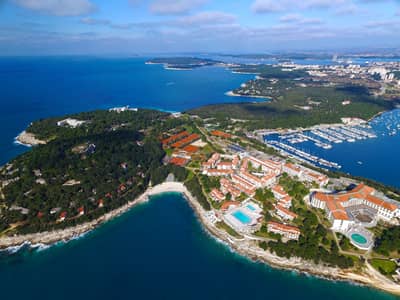
Puntizela
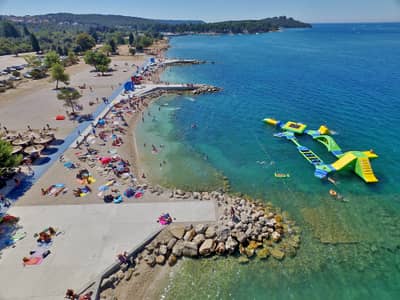
Stoja
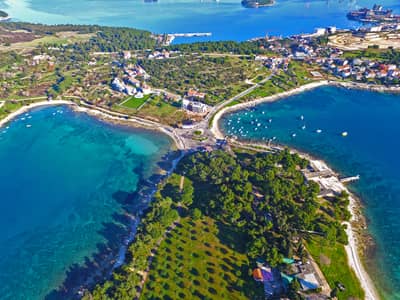
Valkane
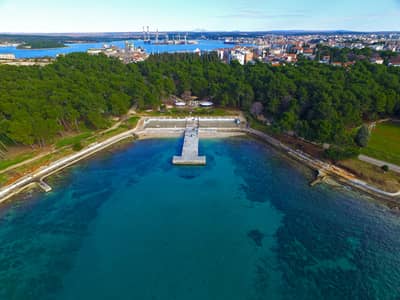
Beach Vile Stinjan, Travel Guide for holidays in Pula, Istria
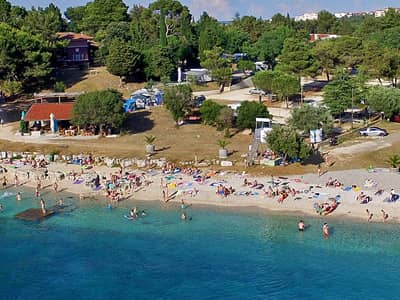
In the southwestern part of Istria, 5km from Pula, in a beautiful bay lies the little place called Štinjan. This is an ideal vacation destination for families because of its beautiful nature and picturesque beaches, Vile is one of the most fascianting beaches in the bay, covered with tiny pebbles and surrounded by rich vegetation. Besides sunbathing and swimming in the clear sea, you can get involved into various sport activities. There is a sandy volleyball field as well as a wide range of water sport activities. The equipment can be rented there, as well as deckchairs. The landscape is fascinating and pleasant for long walks or bike riding. There is also a famous diving centre. Not far from the beach you can see a restaurant, from which you have a beautiful view over the Brijuni Islands while enjoying a wide range of food and beverage offer.
09
Church and Monastery of St. Francis
On the slope of the hill between the Forum and the upper circular street, lies the monastic complex dedicated to St. Francis of Assisi, built in the 14th century at the site of a previous cultic edifice.
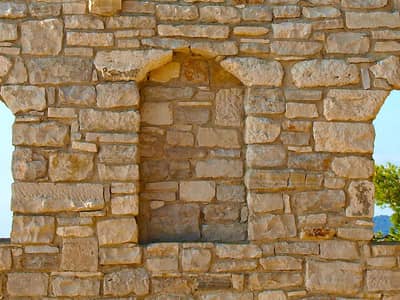
The Franciscan community was first recorded in Pula in the 13th century. The church was built in 1314 in the late Romanesque style with Gothic ornaments, as a firm and simple building of the preaching Franciscan order. The finely cut stone blocks used for building the walls speak of the skilful masters who took part in the construction.
Church of St. Maria Formosa
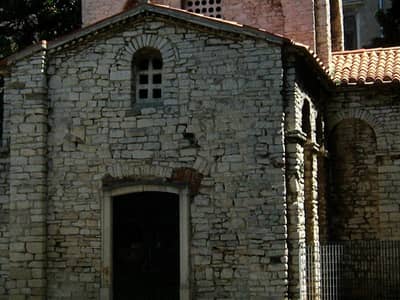
It is one of the two chapels built in the 6th century as part of a large Benedictine abbey demolished in the 16th century. The floor and walls were decorated with mosaics, some of which are now in the Archaeological Museum of Istria.
It was built in the style of Ravenna churches, the only difference being the use of stone instead of brick. Due to its dimensions, method of construction and good state of preservation, the Chapel represents an extraordinary architectural masterpiece of its time.
Cathedral of the Assumption of the Blessed Virgin Mary
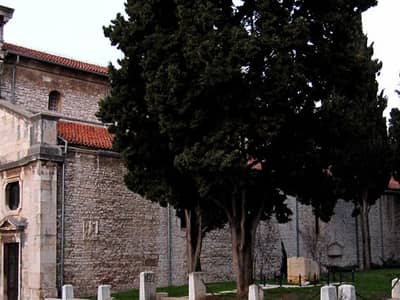
Within the city, along the main street that from Flavia Street leads to the Forum, stands the Cathedral of Pula. It was built at the site where Christians gathered already in the time of their persecution (until the 4th century).
With the ages it grew larger and assumed its present-day shape in the 5th century. It had an elongated oblong shape whose interior was divided by two rows of columns. The area around the altar was in the north, defined by a semi-circular podium with stalls for the clergy. In front of the altar area, behind it and around the very altar, still lie fragments of the floor mosaic from the 5th – 6th centuries, with memorial inscriptions of worshippers who paid for the decoration of the specific surface. The oldest preserved remains of the church wall from the beginning of the 4th century can be seen from outside: the lower part of the rear wall belongs to this period. Due to a fire in 1242 the church underwent reconstruction on several occasions. While the upper windows of the nave were built in the early Christian period, the windows of the aisles bear typical Gothic traits. In front of the church, a baptistery, cross-shaped by ground plan, was built in the 5th century. It was destroyed in 1885. In the beginning of the 16th century a new late Renaissance facade was built, and in front of the church, a belfry was erected in the second half of the 17th century (1671-1707). Stone blocks from the Amphitheater were used for its construction. At the site of the present-day park, east of the Cathedral, until 1657 stood the church dedicated to the patron saint of Pula, St. Thomas. This church too, was built in the 5th century and such twin ecclesiastical complexes were no novelty in Istria (Nesactium, Poreč). After its destruction in the Middle Ages, St. Thomas’ Church was not reconstructed; its surface remains were last evident back in 1812.
Orthodox Church of St. Nicholas
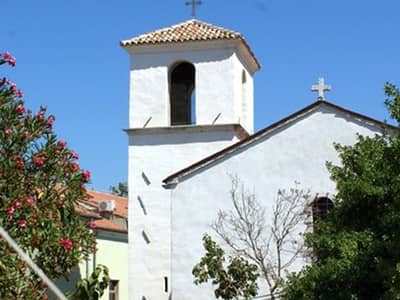
Built in the second half of the 6th century, with a typical Ravenna-like polygonal apse, the church was dedicated to the Blessed Virgin Mary.
After its radical reconstruction around 1200, it was assigned to the Greek Orthodox community in Pula in 1583 formed by immigrants from Cyprus and Nauplion: Today it belongs to the Serbian Orthodox church. It keeps the iconostasis of the Greek master Tomios Batos from the 18th century, valuable icons and other objects.
04

More about Fažana
find out more
Fažana is a village,a municipality, a small port and fishermen’s centre in the south-western part of Istrian. It is located 8 km northwest from Pula right in front of the Brijuni Islands. It’s very easy to reach the Island from the Fazana since is the starting point for excursions to the National Park Brijuni provided with a a daily boat transfer. The town dates from the ancient Roman times when its name was Vasanium and was well-known for manufacturing amphorae, vases and tiles. Infact, in order to revive the Roman history every July, visitors can enjoy the revial of the Fažana Riviera’s Roman past, taste the food the Romans used to eat, and explore their creative side in the workshops of Roman mosaics, amphoras, or even try their hand at a culinary contest where food is made in a “čripnja” – a round dish meant for open-air cooking.
In the old town centre which dates back from medieval times visitors can see the parish church of SS. Cosmas and Damian (XV century)picturesque squares, old close-built houses, narrow stone paved streets as well as three churches (St. Mary of Mount Carmel – IX century, St. John’s XVI cent., St. Eliseus – VI cent.) . The long fishing tradition of this town has resulted in a Fishing academy, where all the people enrolled learn to salt this staple of Adriatic cuisine. Near the town center, the Sardine park along the Fažana promenade brings together different artistic creations, and hosts numerous fish-themed public festivals. During these festivals, held many times during the summertime visitors have a chance to try and learn how to prepare the fish in various diverse ways.
Anyway except for its fishing tradition Fažana is known for its autochtonous wine and olive oil. In the many local restaurants guests can taste exquisite fish and meat dishes, authentic local food served with the Istrian malvasia, made of an autochtonous variety of grape. Visitors to the Fažana Riviera, aside from the gorgeous beaches, have access to numerous biking routes, golf courses, windsurfing school, local manifestation.
Fazana, enriched with natural beauties offers to each guest a relaxin atmosphere.