Discover the destination Medulin
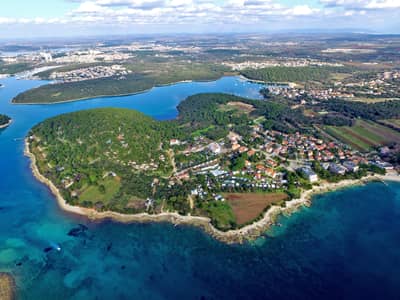
The Beach Bijeca (Medulin, Istria)
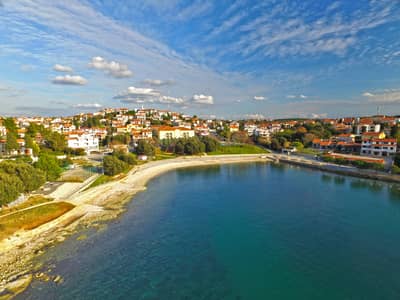
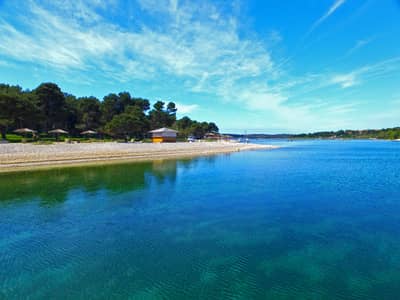
This popular sandy beach extents one km along the coast, and it is attractive for young people who play water games in the shallow water. Directly on the beach you can rent the different equipment for sea fun and sports. Bijeca info
Premantura (Medulin, Istria)
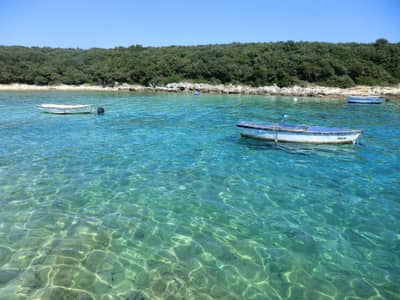
Premantura is enclosed in a nature that not many places can boast of. The southest point of the town is Cape Kamenjak – a protected landscape 9.5 km long, 1.5 km wide, with altogether 30 km of indented and intact coastline. There are rare the places in the world where the sea is so blue-green, so clean as here at the southernmost cape of Istria. Premantura Info
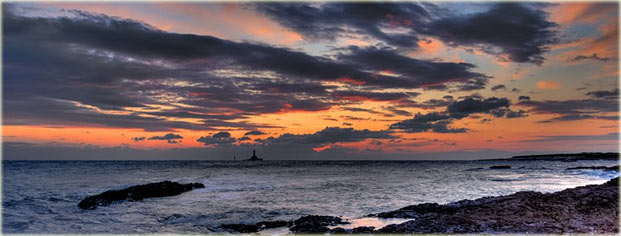
Lighthouse Porer (Medulin, Istria)
It was built in 1833 at the top of the cliff which is bearing the same name. It is situated south-east of the southern cape of the Istrian peninsula. The Lighthouse consists of a high round stone tower and a ground floor building having an area of 220 m2 in total. Porer Info
Medulin archipelago: Ceja, Levan, Bodulas
If you are seeking adventure, visit one of the many small islands of the Medulin archipelago – Ceja, Levan or Bodulaš. They can be easily reached by boat, taxi boat or you can even rent a boat and make it a one day excursion. Moreover, the Medulin archipelago is a heaven for windsurfers, water skies and divers. Another possible activity is go fishing with the local fishermen or dive into the stillness of the underwater world. Maybe, if you"re an adventurer you would like to see it all from above? Then choose a panoramic flight by sports plane.
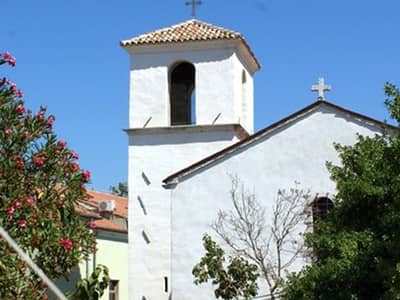
The Church of Saint Agnez (Medulin, Istria)
The Church of Saint Agnez was built in 1893. It is the ony church in Istria with two bell towers which can be seen from a bigger distance. The church is often visited during the summer as a part of the cultural manifestation held in Medulin since there are many concert that are kept inside the church.
Amphitheatre (Arena)
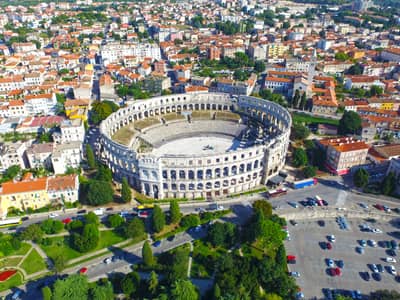
The most famous and important monument, the starting and ending point of every sightseeing tour is the Amphitheater, popularly called the Arena of Pula, which was once the site of gladiator fights. It was built in the 1st century AD during the reign of Emperor Vespasian, at the same time as the magnificent Colosseum in Rome.
The ground plan is elliptical, the longer axis measuring about 130 m and the shorter one about 100 m. Gladiator fights took place in the central flat area called the arena, while the spectators could sit on the stone tiers or stand in the gallery. It is believed that the Amphitheater could seat about 20,000 spectators. Local limestone was used for its construction. In the Middle Ages it was the site of knights tournaments and fairs. Today it is the venue for summer performances - the Film Festival, Opera Season, Equestrian Festival, concerts, ... which can seat about 5,000 spectators. The underground passages, once used by the gladiators, nowadays host a regular exhibition of viticulture and olive growing in Istria in ancient times. The exhibits include reconstructions of machines once used for the production of olive oil and wine (mills, presses, vessels) and amphorae used for storing and transporting olive oil and wine. The Amphitheater is situated outside the old city walls because of its size and geographical configuration. The road that leads to the center was constructed during Emperor Vespasian, after whom it was named - Via Flavia. Even today it represents one of the main city roads.
Forum
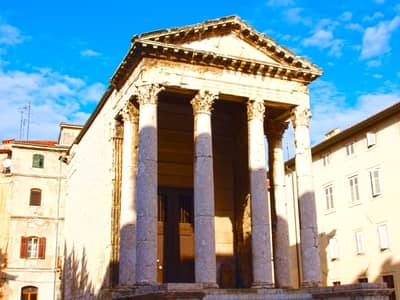
The main square of classical and medieval Pula is situated at the foot of the central hill, in the western part of the city close to the sea. The coast where the Forum was constructed in the 1st century BC had to be filled up to gain a larger area.
The Forum was the nucleus of city life, its religious, administrative, legislative and commercial center. On the northern part of the Forum stood two twin temples and a central one dedicated to Jupiter, Juno and Minerva. Today only the Temple of Augustus has been fully preserved while of the second temple only the back wall, built into the Communal Palace in the 13th century, is visible. Ancient remains of the Forum have been found during the construction of new buildings, the latest ones being "Agrippina and her time" (1st century AD). The remains have been partly restored and are now exhibited in the bank built on the site. Even today the Forum is the administrative and legislative center of the city. During the summer months it is the venue for numerous cultural events.
Communal Palace
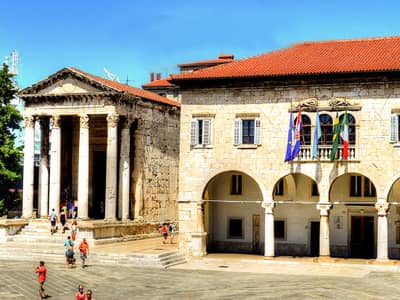
At the time when Pula was a free municipality, a palace was erected in the Forum – the seat of the municipal self-government. During the Venetian rule it was the seat of the duke and provveditore, and until the present has remained the seat of the mayor.
Additions over the centuries (from the 10th -16th centuries) led to a building that in an exceptional way combines architectural styles from the Romanesque until the Renaissance. The inscription built in the facade, which was restored in the 16th century, dates the construction of the Communal Palace to 1296. The year probably refers to the first greater reconstruction and addition, because this was surely the seat of the municipal government even earlier. Earlier phases of the development of the Communal Palace in terms of its construction can best be seen on the eastern wall where Romanesque and Gothic styles intertwine. Sculptures of Telamon and Siren in the corners closed by Renaissance columns, and Baroque windows are the latest alterations of the outer appearance of the Communal Palace: neglect and negligence have left considerable traces on the building that has recently been radically restored.
Gate of Hercules
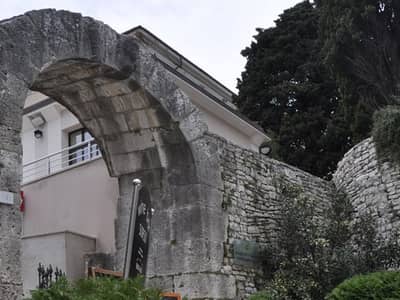
It stands between two, most probably medieval towers, of simple construction built of uncarved stone blocks. At the top of the damaged arch, although hardly recognizable, is a carving of the head of Hercules and his club.
Close to the club is a damaged inscription, most interesting in the historical context since it contains the names of two Roman officials, Lucius Calpurnius Piso and Gaius Cassius Longinus to whom the Roman Senate had entrusted the duty to found a Roman colony at the site of today’s Pula. Thus, between 47 and 44 BC Pula was founded as a settlement with urban features. Since the upper circular street passed though this gate, the axis of communication was obliquely placed with respect to the direction of the city walls.
Castle
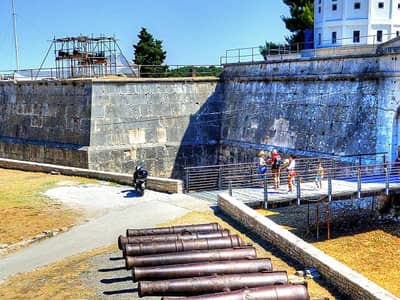
From the upper circular street one of the perpendicular paths leads to the top of the central hill of the city where a star-shaped castle with four bastions was built in 1630.
Wishing to protect the city and its harbor, because of it great significance in maritime trade in the North Adriatic, the Venetians commissioned the building of the Castle from the French military architect Antoine de Ville. This was most probably the site of an earlier fortress dating from the pre-Roman and Roman period. The Histrian hill-fort was primarily built for defensive purposes, whereas in the Roman period a small military garrison was stationed here. Today the Castle houses the Historical Museum of Istria.
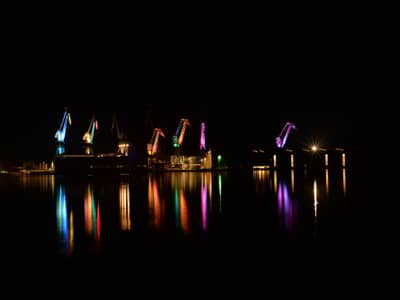
Lighting Giants
Triumphal Arch of the Sergi – Golden Gate
The “Golden Gate” was erected between the years 29 and 27 BC by the Sergi family, in honor of three members of the family who held important positions in Pula at that time. This triumphal arch leaned against the city gate Porta Aurea thus called because of its richly ornamented arch or gilded elements.
The gate and wall were pulled down in the beginning of the 19th century as a result of the city expansion outside the city walls. The Arch was constructed in Corinthian style with strong Hellenistic and Asia Minor influences both in the method and ornaments. As the eastern side was not visible it has remained for the most part uncarved, while the western, town side is richly decorated. Today numerous cultural performances, theatrical and musical, are held on the square next to the Arch. The adjacent street is a shopping area.
_thumb_400x300.jpg)
07
Banjole
Bijeca
Indije
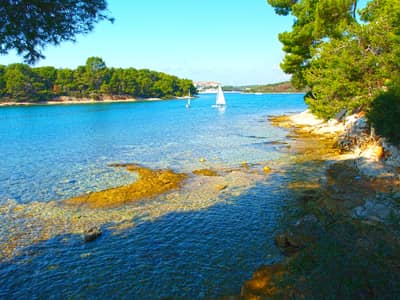
Ližnjanska plaža
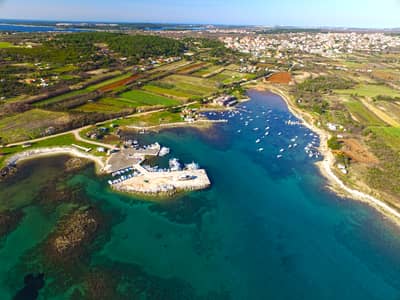
Marlera
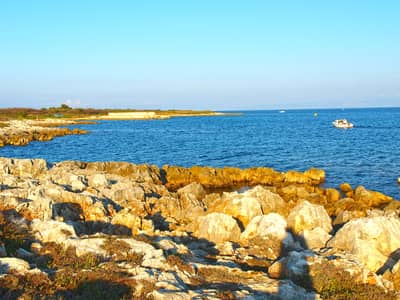
Munte
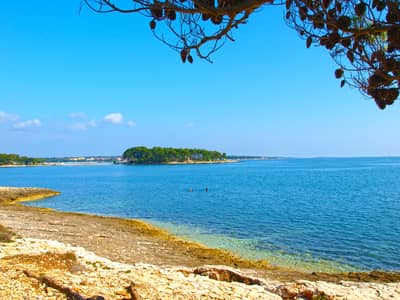
Pješčana Uvala
Pomer
Rt Kamenjak
_thumb_400x300.jpg)
Šišan
10
Church and Monastery of St. Francis
On the slope of the hill between the Forum and the upper circular street, lies the monastic complex dedicated to St. Francis of Assisi, built in the 14th century at the site of a previous cultic edifice.
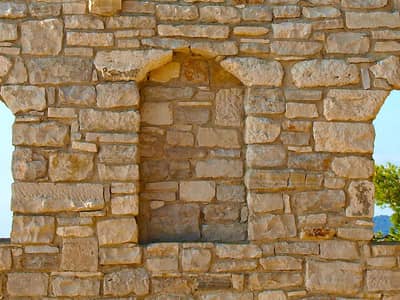
The Franciscan community was first recorded in Pula in the 13th century. The church was built in 1314 in the late Romanesque style with Gothic ornaments, as a firm and simple building of the preaching Franciscan order. The finely cut stone blocks used for building the walls speak of the skilful masters who took part in the construction.
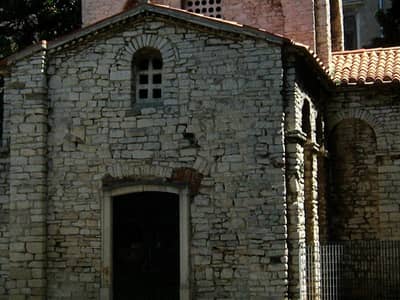
Church of St. Maria Formosa
It is one of the two chapels built in the 6th century as part of a large Benedictine abbey demolished in the 16th century. The floor and walls were decorated with mosaics, some of which are now in the Archaeological Museum of Istria.
It was built in the style of Ravenna churches, the only difference being the use of stone instead of brick. Due to its dimensions, method of construction and good state of preservation, the Chapel represents an extraordinary architectural masterpiece of its time.
Cathedral of the Assumption of the Blessed Virgin Mary
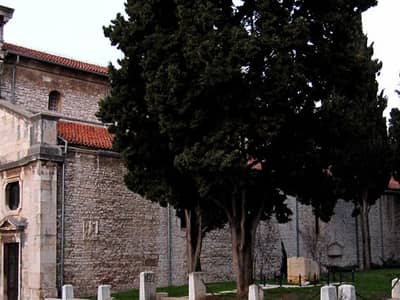
Within the city, along the main street that from Flavia Street leads to the Forum, stands the Cathedral of Pula. It was built at the site where Christians gathered already in the time of their persecution (until the 4th century).
With the ages it grew larger and assumed its present-day shape in the 5th century. It had an elongated oblong shape whose interior was divided by two rows of columns. The area around the altar was in the north, defined by a semi-circular podium with stalls for the clergy. In front of the altar area, behind it and around the very altar, still lie fragments of the floor mosaic from the 5th – 6th centuries, with memorial inscriptions of worshippers who paid for the decoration of the specific surface. The oldest preserved remains of the church wall from the beginning of the 4th century can be seen from outside: the lower part of the rear wall belongs to this period. Due to a fire in 1242 the church underwent reconstruction on several occasions. While the upper windows of the nave were built in the early Christian period, the windows of the aisles bear typical Gothic traits. In front of the church, a baptistery, cross-shaped by ground plan, was built in the 5th century. It was destroyed in 1885. In the beginning of the 16th century a new late Renaissance facade was built, and in front of the church, a belfry was erected in the second half of the 17th century (1671-1707). Stone blocks from the Amphitheater were used for its construction. At the site of the present-day park, east of the Cathedral, until 1657 stood the church dedicated to the patron saint of Pula, St. Thomas. This church too, was built in the 5th century and such twin ecclesiastical complexes were no novelty in Istria (Nesactium, Poreč). After its destruction in the Middle Ages, St. Thomas’ Church was not reconstructed; its surface remains were last evident back in 1812.
Orthodox Church of St. Nicholas
Built in the second half of the 6th century, with a typical Ravenna-like polygonal apse, the church was dedicated to the Blessed Virgin Mary.
After its radical reconstruction around 1200, it was assigned to the Greek Orthodox community in Pula in 1583 formed by immigrants from Cyprus and Nauplion: Today it belongs to the Serbian Orthodox church. It keeps the iconostasis of the Greek master Tomios Batos from the 18th century, valuable icons and other objects.
04

More about Medulin
find out more
Medulin History
The history of Medulin dates back to prehistoric time. There were found ancient settlements, ruins and necropolises that belonged to ancient inhabitants,the Histri. Medulin is known as well, for its findings from the Roman time, as here old Roman villas were located, the most known of which is the one on the Vižula peninsula, the second largest in Istria, which is still visible. It can still be seen that it had 12 kinds of marble and thanks to the objects found inside the villa, it can be established that the former elite lived there. Near the villa archeologists found somee remains of settlements where life existed up to the 6th century.
The inhabitants of this town almost a hundred years ago started to take care about the appearance of their town and in 1909 they founded the Society for Adorning Medulin. At that time the amazing beauties of this area attracted Paul Kupelwieser as well, an Austrian industrial magnate who owned the Brijuni islands. Planning on developing tourism, he bought a part of the Medulin coastline along with the Kaštej peninsula.
Today the municipality and town of Medulin belong to the most representative destination of Istrian tourism since it offers a lot of private accommodatio, hotels, camps.
Medulin Culture
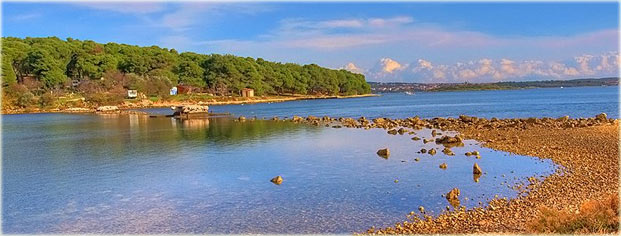
While in Medulin explore the Vižules archaeological site with ruins of Roman villas and tour the old windmills by the sea. While enjoying the various offerings of Medulin, take some time to visit ancient Pula, Istrian Mummies, National Park Brijuni, National Park Plitvice Lakes, Nature Park Cape Kamenjak, Venice and many other beautiful sights on the Istrian peninsula. At one of the many festivities held during the summertime you can try some of the specialties of Medulin such as crab sald, cuttlefish risotto, Istrian prosciutto or any of the aromatic specialties made with truffles. You can enjoy yourself and relax during concerts of classical music, visit restaurants and dance on their terraces or visit one of the night clubs and entertain yourself until the morning. While in Medulin, don’t miss the opportunity to visit other nearby tourist centers such as Rovinj, Poreč, Pazin and Umag.
Medulin – Things to do
While in Medulin enyoing your vacation you can visit some of the islannd of the Medulin arrchipelago. It is a real paradies for lovers of nature. Islands Ceja, Levan, Bodulaš are perfect for the whole day excursion since they offer catering facilities. Besides the Medulin archipelago is ideal for windsurfers, water skies and perfect for diving. You can reach all islands by your own boat, taxi boat or you can rent a boat.
Also, Medulin Riviera is ideal cyclists since the area has one of the most beautiful mountain bike trails in Istria. The Medulin trail is about 60km long and the main trail consists of four additional ones. In Medulin there are also many other possibilities such as horse riding, tennis, beach volleyball. While enjoying the various offerings of Medulin, take some time to visit ancient Pula, Istrian Mummies, National Park Brijuni, Nature Park Cape Kamenjak, Venice, Baredine Cave or take part of a panoramic flight over the whole area. Furthermore at one of the many festivities held during the summertime you can taste some of the specialties of Medulin such as crab sald, cuttlefish risotto, Istrian prosciutto or any of the aromatic specialties made with truffles. You can enjoy and relax during concerts of classical music, dance on open terraces or visit one of the night clubs and entertain yourself until the morning.
Medulin – Entertainments and events
Medulin is ideal for young people. Especialy during the summertime there are many beach bars and several clubs that offer entertainment and an exciting night life such as Summer Club, Imperial, Barracuda beach bar and others. The more more mature population may choose to spend their evenings on summer terraces where is offerend various types of live music.
Medulin – Service Information
Regional Number Code 052
Police Department 192;
Fire Department 193;
Emergency 194;
Bus Station 502-997;
Airport Pula 550-900;
Ambulance 376-000;
Harbour/Ferry 222-037;
Tourist Office 577-145;
Railway Pula 541-733;
General Information 981.
Medulin – How to reach us
You can reach Medulin from many directions and with various transportations: By bus which connects the city Pula and Medulin as well as a local bus that connect Medulin with the nearer locationsa; By train from the train station in Pula and then from here by bus oder taxi; By boat to the major ports or by personal boat to the smaller ports or marinas in the city; By plane to the airport Pula and by organized bus to the city: By personal vehicle which is the most secure and individual way of traveling. Medulin has its own exit on the Istrian Y, which is the main road that connects all the biggest location in Istria.