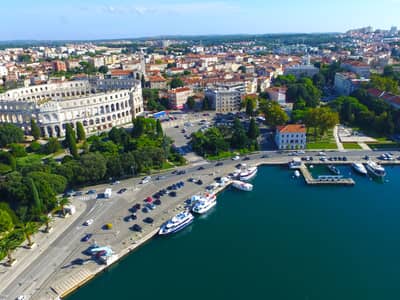
Apartment 34 Pula is situated in Pula (Region Istria).
Apartment 34 Pula has 1 accommodation units: Apartment for 4 persons with 3 bedrooms.
Apartment 34 Pula is located 3000m from the center and 1000m from the beach.
Apartment 34 Pula is suitable for: Budget accommodation. Check your appartment availability and find out the price, discounts and special offers. We Guarantee you the best possible price.
Book online!
Apartment for 4 persons with 3 bedrooms has 4 beds (basic beds: 4 and extra beds: 0).
The area of the apartment is 60m2 and is situated on the 0 floor.
Apartment for 4 persons with 3 bedrooms has: Internet, Tv.
More info about equippment here.
Price Apartment for 4 persons with 3 bedrooms is from € 54.00 to € 96.00.

General info
Location
-
Settlement type:Quiet location, Inhabitated
-
Greenery:High
-
Isolation
-
Main Road Before Beach
-
Access By Car
-
By The Beach
-
Beach type:Pebble, Stone
-
Beach access:Short shoal
Distances
Discover destination Pula
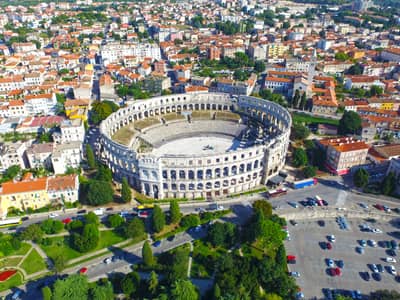
Popularly called the Arena of Pula, it was bulit in the 1st century AD during the reign of Emperor Vespasian and it became the ancient monument in the center of Pula. 3000 years ago it hosted the popular gladiator fights which took place in the central flat area called the arena, but today many summer performances take place in the same place where gladiator had fought in the Roman time. It is the 6th largest ancient amphitheater in the world.
Beaches
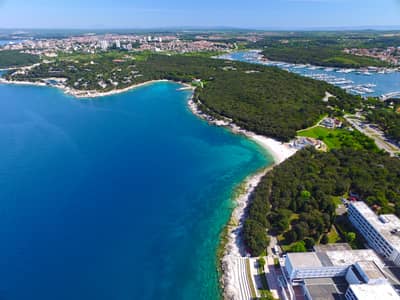
Ambrela
Beach Ambrela is placed right at the entrance into the tourist zone Verudela. Because of its cleanliness and exceptional water quality, it has been awarded the Blue Flag. It attracts especially families with children beacause it has an accesible entrance into the sea . On the beach you can rent deck- chairs and parasols, and there can be found cabins and showers. It’s possible to rent different water and beach sports equipment.The lifeguard service oberves swimmers throughout the day in order to keep all the simmers safe. In the sea has been set the swimmers sea border line. A few meters from the beach, you can find shade as well as two snack bars where you can always refresh.
Hawaii
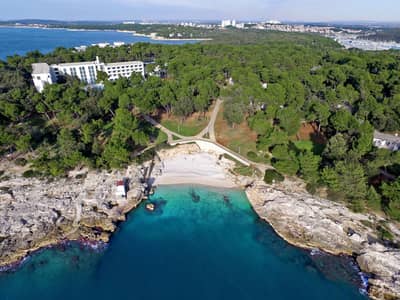
Histria
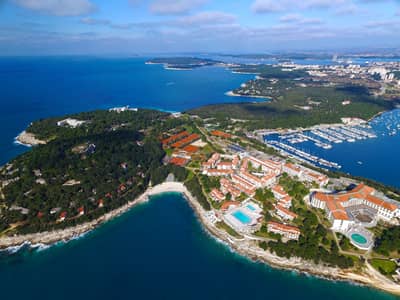
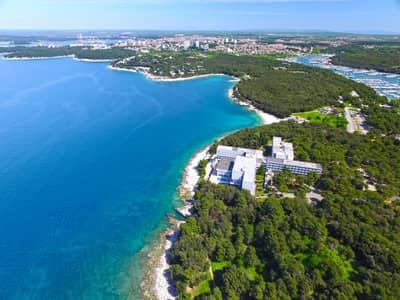
Brioni
04
Things to do & see
Bijeca
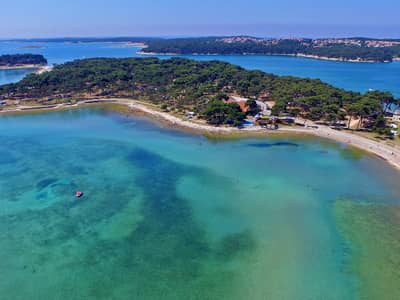
Rt Kamenjak
_thumb_400x300.jpg)
Brijuni
The Maker wanted to shape a part of the Earth as an image of Heaven. That is how Istria was born and how like a garden covered with marvelloust trees and wide meadows, washed by the deep blue sea, appealing people to a happier life. But the jealous devil destroyed his work by tearing the sack where the angel was carrying the unused stones. Thousands of rocks spread around the Istrian land making it a land of contrasts, gentle and rough, fertile and barren, sunny and cloudy.
The unhappy angels gathered the pieces of Heaven remaining among the scattered rocks and protected them by the sea waves and that how Brijuni was created. The Brijuni archipelago extends along the south west coast of the peninsula of Istria. The islands consist of two large islands, Veli (big) Brijun and Mali (small) Brijun plus twelve other smaller islands. For travellers from all around the world, National Park Brijuni has become one of their favourite holiday destinations with its incredible beauty, and mild climate since the beginning of the 20th century. The coas of the island is mostly low and rocky, but very accessible, with a few sandy and pebble bays. The colourful islands have been attracting people since ancient times for its tranquillity and natural beauty. The islands have been populated since the Roman age, and the remains of many luxurious Roman villas prove to the fascinating beauty of the archipelago. The most significant of the remains on the islands are in the bay of Verige, part of which were found temples to the god Neptune and the goddess Venus. On the west coast of the island of Veli Brijuni, in the gulf of Dobrika, the Byzantine castles and the basilica of St. Mary are located. These ruins confirm the existence of settlements from the 16th century. The white villa on the island in Veli Brijuni was the residence of Joseph B. Tito, during his reign as presidents of Yugoslavia and there he received many public officials and delegates. As he was an animal lover, he received many as gifts from visitors from all parts of the world. Today there are more than 600 indigenous plant species, mostly Mediterranean, and in the northern part of Veli Brijun there is a safari park where there are deer, zebra, ostriches, giraffes and other animals. Golf lovers can enjoy playing and nature. By renting bicycles at the park the guests can experience the park in a different way.
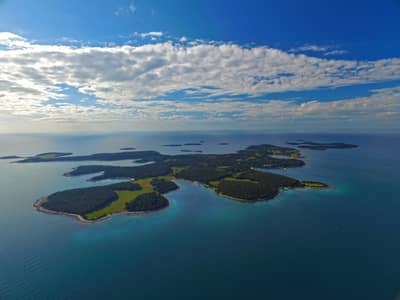
Porer
Amphitheatre (Arena)
The most famous and important monument, the starting and ending point of every sightseeing tour is the Amphitheater, popularly called the Arena of Pula, which was once the site of gladiator fights. It was built in the 1st century AD during the reign of Emperor Vespasian, at the same time as the magnificent Colosseum in Rome.
The ground plan is elliptical, the longer axis measuring about 130 m and the shorter one about 100 m. Gladiator fights took place in the central flat area called the arena, while the spectators could sit on the stone tiers or stand in the gallery. It is believed that the Amphitheater could seat about 20,000 spectators. Local limestone was used for its construction. In the Middle Ages it was the site of knights tournaments and fairs. Today it is the venue for summer performances - the Film Festival, Opera Season, Equestrian Festival, concerts, ... which can seat about 5,000 spectators. The underground passages, once used by the gladiators, nowadays host a regular exhibition of viticulture and olive growing in Istria in ancient times. The exhibits include reconstructions of machines once used for the production of olive oil and wine (mills, presses, vessels) and amphorae used for storing and transporting olive oil and wine. The Amphitheater is situated outside the old city walls because of its size and geographical configuration. The road that leads to the center was constructed during Emperor Vespasian, after whom it was named - Via Flavia. Even today it represents one of the main city roads.
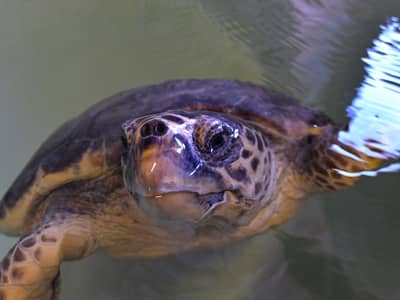
Aquarium Pula
Aquarium Pula isplaced in the Austro-Hungarian fortress Verudela, which was built in 1886 on the peninsula 3 km from the city centre of Pula. The works to transfor the fortress into the aquarium has been in progress since 2002. The installation has been set in about 60 tanks on the ground floor, the moat, and the first floor of the fortress. In an area of approx. 2000 m2 visitors can get acquainted with inhabitants of Northern and Southern Adriatic Sea, tropical marine and freshwater fish and with exemplary of European rivers and lakes.
From the roof of the fort, a beautiful view over the entire city of Pula and Istria extents to the distant horizont, while in the moat you can enjoy refreshments on our summer terrace.
Content:
Fortress Verudela
– Fortress with preserved rooms, tunnels and a moat
– Roof: Belvedere
– Moat with caponiers
– Exhibition of photographs with fortresses from Pula
– Exhibition of works from the International Fortification Architecture Workshops
Aquarium
Central part
– Central aquarium of 300 m3 for sharks
Ground floor
– Northern Adriatic flora and fauna
– NW caponier: Evolution exhibition with living fossils and reptiles
– SE caponier: fish from European rivers and lakes, shelter for red-eared slider turtles, summer terrace, interactive exhibition “The Park of Physics”
1st floor
– Southern Adriatic and Mediterranean flora and fauna
– Tropical marine
– Freshwater fish
– Marine Turtle Rescue Centre
– Projection of short educational movie “Posidonia oceanica“
– Marine chemistry and biology laboratories
– Sea horses room
For those who want to know more (during summer season)
– Demonstrations of marine biology or chemistry in our laboratories (included in the ticket price, TUE and THU, 11:00 – 12:00)
– Viewing during feeding time (included in the ticket price, from MON to FRI; 12:00 – 13:00)
– Oceanographic programme “Blue School” on the boat (up to 4 hrs, additional payment is required)
WORKING HOURS:
April, May and September 10.00 – 18.00 h
June – August 09.00 – 22.00 h
October – March 10.00 – 16.00 h
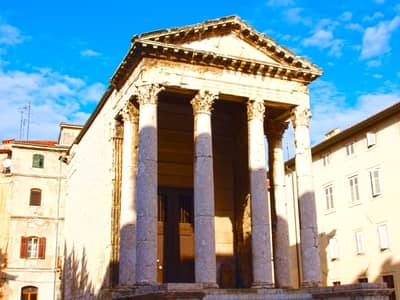
Forum
The main square of classical and medieval Pula is situated at the foot of the central hill, in the western part of the city close to the sea. The coast where the Forum was constructed in the 1st century BC had to be filled up to gain a larger area.
The Forum was the nucleus of city life, its religious, administrative, legislative and commercial center. On the northern part of the Forum stood two twin temples and a central one dedicated to Jupiter, Juno and Minerva. Today only the Temple of Augustus has been fully preserved while of the second temple only the back wall, built into the Communal Palace in the 13th century, is visible. Ancient remains of the Forum have been found during the construction of new buildings, the latest ones being "Agrippina and her time" (1st century AD). The remains have been partly restored and are now exhibited in the bank built on the site. Even today the Forum is the administrative and legislative center of the city. During the summer months it is the venue for numerous cultural events.
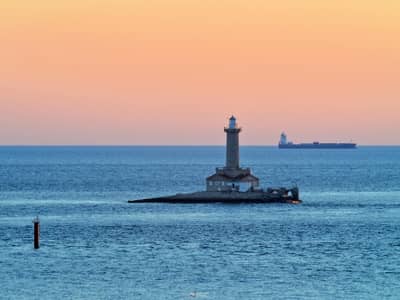
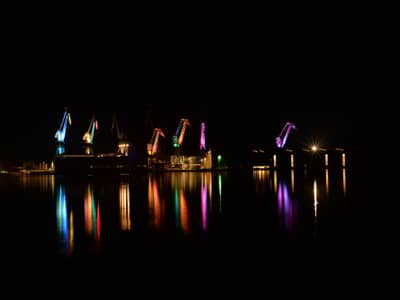
Lighting Giants
Triumphal Arch of the Sergi – Golden Gate
The “Golden Gate” was erected between the years 29 and 27 BC by the Sergi family, in honor of three members of the family who held important positions in Pula at that time. This triumphal arch leaned against the city gate Porta Aurea thus called because of its richly ornamented arch or gilded elements.
The gate and wall were pulled down in the beginning of the 19th century as a result of the city expansion outside the city walls. The Arch was constructed in Corinthian style with strong Hellenistic and Asia Minor influences both in the method and ornaments. As the eastern side was not visible it has remained for the most part uncarved, while the western, town side is richly decorated. Today numerous cultural performances, theatrical and musical, are held on the square next to the Arch. The adjacent street is a shopping area.
_thumb_400x300.jpg)
09