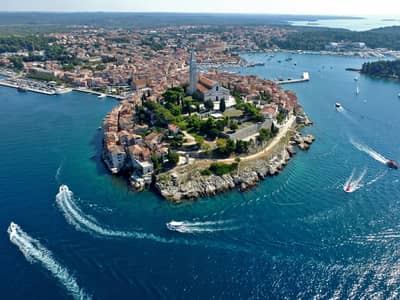
Rooms 2393 Rovinj is situated in Rovinj (Region Istria).
Rooms 2393 Rovinj has 1 accommodation units: Double room.
Rooms 2393 Rovinj is located 700m from the center and 800m from the beach.
Rooms 2393 Rovinj is suitable for: Romantic accommodation. Check your appartment availability and find out the price, discounts and special offers. We Guarantee you the best possible price.
Book online!
Double room has 2 beds (basic beds: 2 and extra beds: 0).
The area of the apartment is 15m2 and is situated on the 2 floor.
Double room has: Internet, Tv.
More info about equippment here.
Price Double room is from € 60.00 to € 78.00.

General info
Location
-
Settlement type:Inhabitated, Quiet location
-
Greenery:Medium
-
Isolation
-
Main Road Before Beach
-
Access By Car
-
By The Beach
-
Beach type:Pebble, Stone, Concrete
-
Beach access:Short shoal
Distances
Discover destination Rovinj
Rovinj, an old but popular fishermen town surrounded by islands and islets, is situated on Istria's west coast and it's one of the most developed seaside resorts in Croatia. Rovinj is an important historical and cultural Istrian center. The old town lies on a conical promontory which was until 1763 part of a coastal islet. In the 18th century the channel was filled up with the mainland. In the 18th century Rovinj was the most populated town in the Ventian part of Istria after Kopar.
Beaches
Stari grad Monte
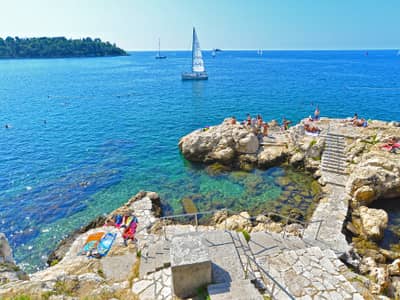
On the west side of the Old Town Rovinj is situated the Monte beach. Although the beach is about 150 meters long, the locals divided it into several parts. The Big and Small Gugulijera are small beaches, suitable for small children to swim, while Baluota (or Balota) and Lanterna are beaches which adults prefer (you can go into the sea water by climbing down or diving from the rocks). The beaches are rocky, with no natural shade, motor vehicle traffic is forbidden in the Old Town, which means you will have to get to this beach by foot or by bicycle.
Uvala Lone
02
Things to do & see
Katarina
Bale
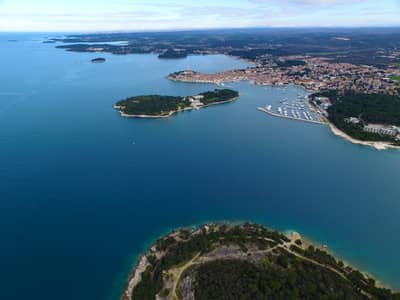
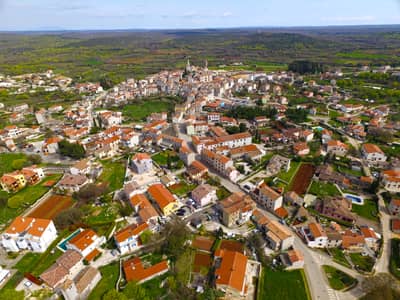
The district of Bale, located near Rovinj,Vodnjan, Kanfanar and Svetvincenat is a preserved area of Istria that has avoided all forms of devastation and today the locals can say with great pride that their home is an area of natural beauty surrounded by natural wealth, untouched nature and rich cultural and architectural heritage. The district of Bale spreads over 81, 65 square kilometres and has a population of 1295 people.
The town of Bale, entirely made of stone,was built on the top of the limestone fortress. It symbolizes Istrian tradition and it existed, according to archaeological research, since the Roman period when it was known under the name Castrum Vallis. Fort Bale protected the trade route between Pula and the interior of the peninsula. The Roman Castrum became a walled little town in medieval times. Today the Roman Castrum Vallis is a small town whose historical core is located 145 meters above the sea level, surrounded by hills. The Italian name „Valle“ means valley, and Bale is the valley positioned between hills Monleme, Skvacota, Pizanovac and Veli Majan; Pastrovicev vrh, Sv Nedjelja, Brigonera, Mongrizeja and Sokol. The most interesting buildings preserved to our days are Venetian Gothic building of the court and the Gothic Renaissance castle form th 15th century which was the residence of the family Soardo Bembo. The area of Bale forms a whole with arable land, pastures, forests in which one can easily come across the remains of old buildings, Roman roads, water tanks, wells, Roman villas, oil presses, churche. From religious buildings there is a church from the 14th century deidcated to St. Anthony and the Romanesque church of St. Elizabeth. The 45th parallel goes straight through the narrowest part of the district of Bale, which means that the district is ideally positioned as regards the planet – half way between the Equator and North Pole. The average temperature in Bale is 14 degrees centigrade and the town has 2400 sunny hours on average a year, which has attracted huge numbers of tourists to the place – a treasure surrounded by the greenness of the flora and blueness of the sea.
Dvigrad
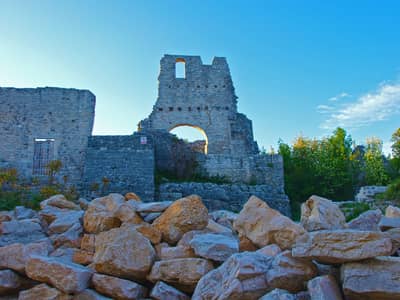
Dvigrad (Twin-town) is an abandoned medieval town in central Istria on the Rovinj – Pazin road in direction of Kanfanar. It is located in the Draga valley. The history of the settlement is prehistoric; it remained inhabited until the 18th century, after the plague the inhabitants left the village and founded a new town, Kanfanar.
During Illyrian times existed two colonies which later, in early mediaeval times, became two towns, Parentino and Moncastello. The former quickly extinct, but the latter, in the ownership of the Aquileian patriarch, developed further under the name of Duecastelli.It can be reconstructed that inside the walls people lived here and that the village and the basilica of St.Sophia existed from the 11th century. In the mid 17th century malaria and the plague were prevailing in Istria, which didn’t spare the citizens of Dvigrad either. Thus, in 1631 most of the 700 hundred inhabitants left the town, and the remaining three families left in 1714, when the church was abandoned as well. The ruins and the pulpit from the 14th century were bought into the church of St. Silvester in Kanfanara, where the inhabitants of Dvigrad had moved as well. The town is very well maintained, since it hadn’t been destroyed in the wars that were ravaging through Istria, but rather because it was abandoned by the inhabitants of the town. The town gates still exist, as well as two circles of the town walls, some of the defense towers are preserved, as well as the most part of the 200 houses. The St. Sophia Church was an early Christian church with three naves which dominated the town and which was built on solid rock. Unfortunately, because the church wasn’t maintained, it decayed in the 19th century. Until recently, the town has been left to snakes, the macchia, the north-eastern wind and to the scatters of time, but lately it is undergoing restauration, so that Dvigrad has become a must for everybody who finds oneself closeby. It is only a 20 minute car ride away from Rovinj.
Lim Channel
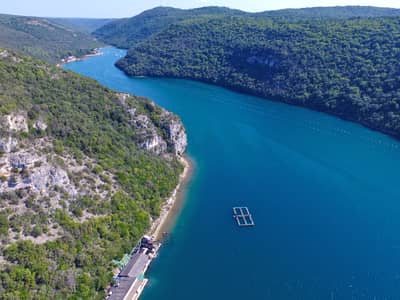
The Lim valley (Limska draga or Limska dolina) is the 35 km long valley of the river Pazinčica, which transforms into the Lim bay (Limski zaljev), a 10 kilometer long estuary. Lim Bay got its name from the Latin word limes meaning border because the bay was a natural border between the two Roman provinces. The Croats sometimes call it Limski kanal (Lim Channel), due to its narrow width. The estuary is sometimes called a fjord, even if it is not in fact a fjord but a ria, because it was not carved by a glacier but by the river eroding the ground on its way to the Adriatic Sea, when the sea level was lower.
The Lim valley (Limska draga or Limska dolina) is the 35 km long valley of the river Pazinčica, which transforms into the Lim Channel (Limski kanal), a 10 kilometers long estuary. Estuaries and coastal waters are among the most productive ecosystems on Earth, providing ecological, economic, cultural, and aesthetic benefits.The estuary is sometimes called a fjord. Even if the movie The Vikings starring Kirk Douglas was shot there in 1958, it isn’t a fjord but a ria, since it wasn’t carved by a glacier but by the river eroding the ground on its way to the Adriatic Sea. The area around the channel has been inhabited since the Neolithic era. Under the Romans, the channel built the border between the administrative units of Porec and Pula. At the beginning of the 11th century it was the home of the hermit St.Romuald who founded the monastery of St. Michael near Kloštar. Today the 105m long St Romuald’s cave is open for visits in the summertime. Fishing in the Lim Channel has always been excellent. Now the natural species have been increased by farmed mussels and oysters which are offered in two excellent restaurants on the channel. The easiest way to visit the Lim Channel is to take part in an organised excursion from Rovinj but it’s also possible to visit it independently. Many excursion boats make hour-long runs up the channel from the main dock. The main season is from June to September and the boats run every hour. There’s a small beach shaded by pines right next to the dock.
Palud
Old Town
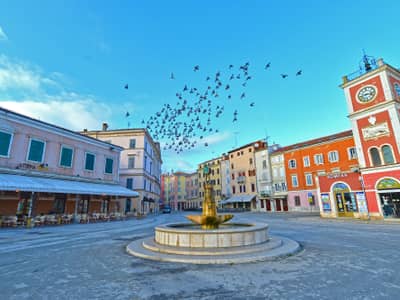
Rises up on a peninsula and is a witness to times gone by and the valuable accomplishments of its past artisans. The limited space led to the construction of narrow buildings, streets and small town squares.
Of particular interest in this town centre are the characteristically designed chimneys. The town itself was declared a cultural monument in 1963.
Church of St. Euphemia
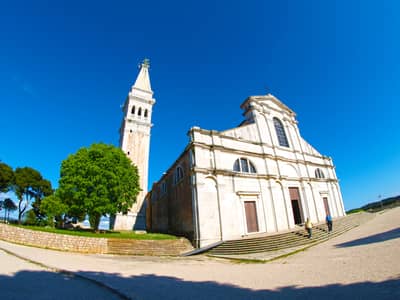
Is a most imposing structure which bears the name of the patron saint of the town. It dominates the whole old town centre.
It was built in the eighteenth century, while its façade in Venetian-baroque style was added in the middle of the last century. At the top of the sixty-metre-high bell tower stands the copper statue of St. Euphemia, which shows the direction of the wind by turning on a spindle.
Parenzana
Crveni Otok
09