Odkryj cel podróży Rovinj
„Crveni Otok" Red Island (Rovinj, Istria)
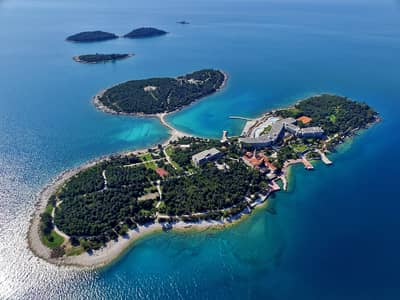
For those who are interested to explore Rovinj and its beautiful surrounding there is an island Crveni otok where is located an interesting Institute of Marine Biology. The island actually consist of two islands named St. Andrew and Maškin. Red Island Info
Lim valley (Rovinj, Istria)
The Lim valley (Limska draga or Limska dolina) is the 35 km long valley of the river Pazinčica, which transforms into the Lim bay (Limski zaljev), a 10 kilometer long estuary. Lim Bay got its name from the Latin word limes meaning border because the bay was a natural border between the two Roman provinces. The Croats sometimes call it Limski kanal (Lim Channel), due to its narrow width. The estuary is sometimes called a fjord, even if it is not in fact a fjord but a ria, because it was not carved by a glacier but by the river eroding the ground on its way to the Adriatic Sea. Lim info
The Grisija (Rovinj, Istria)
Surely among the most known trademarks of ancient Rovinj, Grisija is a picturesque cobbled and sprial street with playful shiny stone pillars.
Forest park Punta Corente (Zlatni Rt) (Rovinj, Istria)
Golden Cape (Zlatni rt/Punta corrente), Kurent Bay and Montauro Cape are situated around 1.5 km away from the town-center, south of the ACI Marina and Lone Bay. The coast is rocky for the most of the part. There are a few beaches covered with small round stones, and Kurent Bay, the most visited beach in this area, covered with gravel. Punta Corente Info
Monfiorenzo cave (Rovinj, Istria)
Near the road Rovinj-pula, about 2 kilometers far from the centre of the City of Rovinj, in the locality of Monfiorenzo, is located the quarry phantasy, a geological parc of extraordinary beauty and importance. According to expert opinion of many scientists, it is one of the most significant nature landmarks in the world regarding the karst phenomenon. The lime-stone of the quarry phantasy, give evidence for the history of the evolution of the terrestrial crust. Monfiorenzo cave info
The Palud Marsh And The Dvije Sestrice Islands (Rovinj, Istria)
The Palud cove, 8 kilometres southwest of Rovinj, is the only ornithological park in Istria. Palud is a natural depression quite close to the sea, which because of the inflow of water from the surrounding hills and uplands, as well as springs on the northern side has transformed into a swamp. Palud Marsh Info
Dvigrad
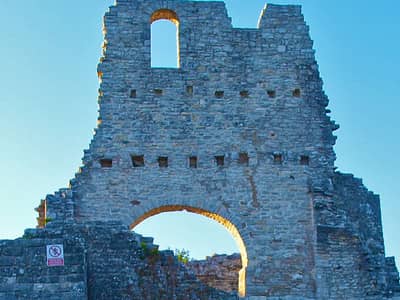
Dvigrad (Twin-town) is an abandoned medieval town in central Istria on the Rovinj – Pazin road in direction of Kanfanar. It is located in the Draga valley. The history of the settlement is prehistoric; it remained inhabited until the 18th century, after the plague the inhabitants left the village and founded a new town, Kanfanar.
During Illyrian times existed two colonies which later, in early mediaeval times, became two towns, Parentino and Moncastello. The former quickly extinct, but the latter, in the ownership of the Aquileian patriarch, developed further under the name of Duecastelli.It can be reconstructed that inside the walls people lived here and that the village and the basilica of St.Sophia existed from the 11th century. In the mid 17th century malaria and the plague were prevailing in Istria, which didn’t spare the citizens of Dvigrad either. Thus, in 1631 most of the 700 hundred inhabitants left the town, and the remaining three families left in 1714, when the church was abandoned as well. The ruins and the pulpit from the 14th century were bought into the church of St. Silvester in Kanfanara, where the inhabitants of Dvigrad had moved as well. The town is very well maintained, since it hadn’t been destroyed in the wars that were ravaging through Istria, but rather because it was abandoned by the inhabitants of the town. The town gates still exist, as well as two circles of the town walls, some of the defense towers are preserved, as well as the most part of the 200 houses. The St. Sophia Church was an early Christian church with three naves which dominated the town and which was built on solid rock. Unfortunately, because the church wasn’t maintained, it decayed in the 19th century. Until recently, the town has been left to snakes, the macchia, the north-eastern wind and to the scatters of time, but lately it is undergoing restauration, so that Dvigrad has become a must for everybody who finds oneself closeby. It is only a 20 minute car ride away from Rovinj.
Dvorac na otoku Sv. Andrije
The castle on the island of St. Andrija was originally a Benedictine Monastery established in the sixth century AD.
In the fifteenth century the Franciscan order added extensions and it was again refurbished at the end of the nineteenth century by Baron Hutterodt. The castle has now been converterd into a hotel.
Gradski bedemi i vrata
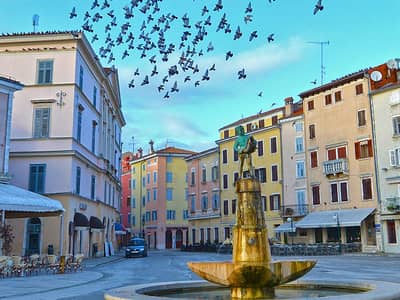
By the seventh century AD, Rovinj was already surrounded by town walls, and later strengthened by the construction of towers.
The old town had seven gates, while three still exist today: the Saint Benedict Gate, the Portico and the Holy Cross Gate. A baroque archway called “Balbijev luk”, which today serves as the entrance into the old town, was built on the site of the former outer gate in the seventeenth century.
Old Town Rovinj
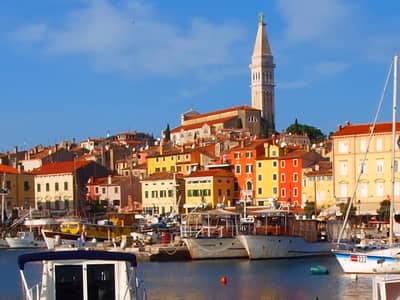
Rises up on a peninsula and is a witness to times gone by and the valuable accomplishments of its past artisans. The limited space led to the construction of narrow buildings, streets and small town squares.
04
Amarin
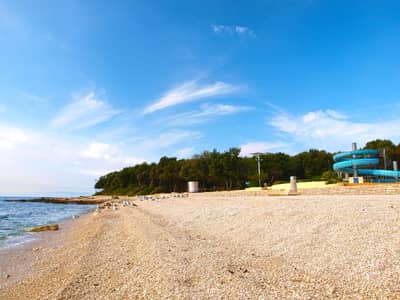
Cisterna
Crveni Otok
Dagita
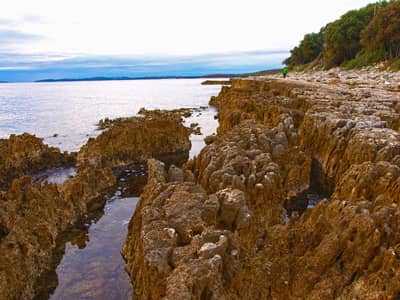
Koronsun
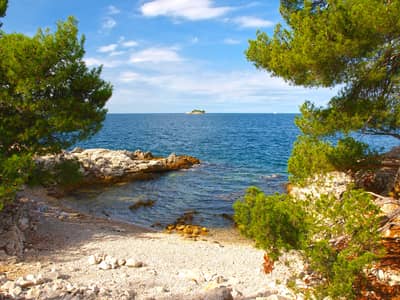
Kurent
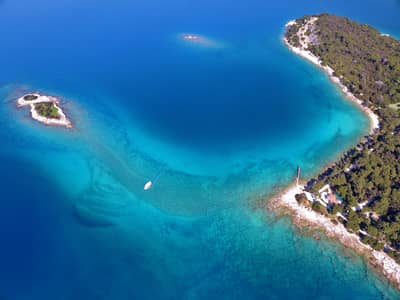
Kuvi
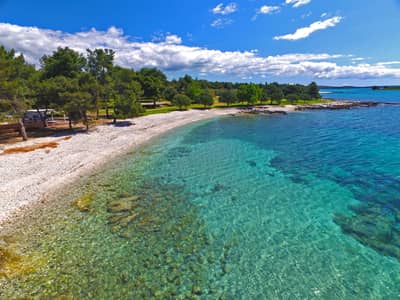
Otok Katarina
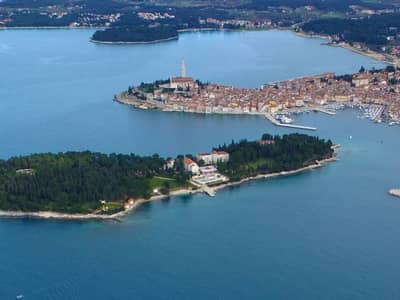
Polari
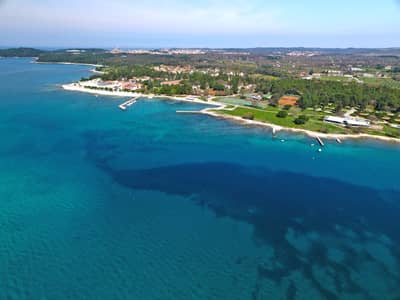
Rt Babo
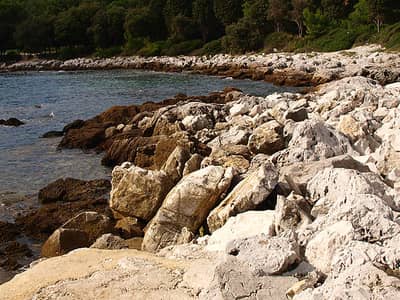
Cape Babo is locatedabout 5 km distance from Rovinj and represents the coast where the so-called wild beaches start, that is beaches, where there are no sports grounds, sanitary facilities and neither gastronomic nor other services. But, Cape Babo is located near the campsite Veštar, so the tennis field or a bar is 10 15 minutes away on foot. The beaches are mainly stony with a difficult access to the sea, but every 50 to 100 meters there are more accessible little bays that are more attractive for those people who would like to spend their summer holiday surrounded by nature, peace and quiet.
10
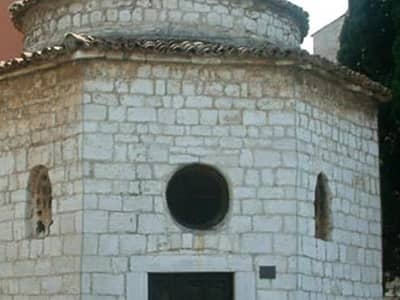
Krstionica Sv. Trojstva
Has been constructed in a heptagonal shape and is the oldest relic situated in the Lokva Square.
The thirteenth century Romanesque church which houses the font is also interesting because of the detailed carvings of the transenna depicting scenes of Golgotha.
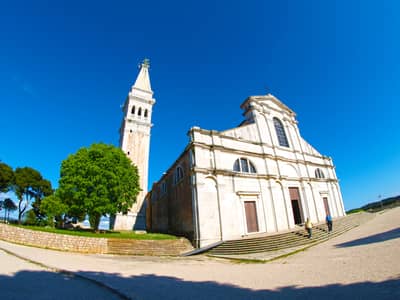
St. Euphemia
It was built in the eighteenth century, while its façade in Venetian-baroque style was added in the middle of the last century. At the top of the sixty-metre-high bell tower stands the copper statue of St. Euphemia, which shows the direction of the wind by turning on a spindle.
02

Więcej o Rovinju
dowiedz się więcej
Rovinj – Historyczne
Rovinj, stare, ale popularne miasto rybackie otoczone wyspami i wysepkami, znajduje się na zachodnim wybrzeżu Istrii i jest jednym z najbardziej rozwiniętych nadmorskich kurortów w Chorwacji. Rovinj jest ważnym historycznym i kulturalnym centrum Istrii. Stare miasto leży na stożkowatym przyladku, które do 1763 r. było częścią przybrzeżnej wysepki. W XVIII w.
Rovinj zostało wypełnione kontynentem. W XVIII w. Rovinj był najbardziej zaludnionym miastem w Ventian, części Istrii po Kopar.
Miasto jest starożytną osadą sławną setki lat temu, gdy starzy Grecy i Rzymianie walczyli o te tereny i pozostawili tu swoje ślady. Miasto zostało po raz pierwszy wspomniane w VII wieku jako Castrum Rubini. Rzymianie zbudowali port na wyspie, która w roku 1763 została włączona do kontynentu. W ciągu kolejnego stulecia, populacja Rovinj zawsze poszukiwała ochrony św. Eufemii. Poświęcona świętej katedra dominuje nad miastem i chroni je. Inne ważne skarby to: Stare Miasto, Barokowy Magistrat, Kaplica św. Trójcy, Klasztor Franciszkański, Zamek na wyspie św. Andrzeja i wiele innych. Bezcennym zabytkiem jest „Seven Old Town Gates" (Siedem Bram Starego Miasta), z których tylko trzy bramy zachowały oryginalny kształt: Brama św. Benedykta, Brama pod Murem i Brama Św. Krzyża.