Objevte destinaci Novigrad
City harbour Mandrač (Novigrad, Istria)
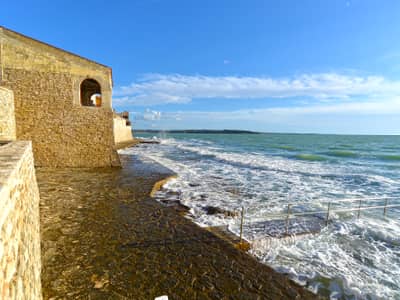
City harbour, the popular Mandrač, in history was the centre of Novigrad’s life as a small fishing village. Once a central place of economic activities, Mandrač maintained in part, the status of a fishing port, thereby continuing the old tradition, which connects Novigrad and its people to the sea. Therefore, Mandrač is one of the most important symbols of Novigrad, which gives the city a recognizable Mediterranean charm.
City walls Novigrad (Istria)
The historic center of the city was once entirely surrounded by the city walls, the course of which remains noticeable also today, as a symbol of the city. In the 13th century, with the fall of the city and under the rule of Venice, the walls were rebuilt on the remains of Late Antique fortifications. The walls were renewed repeatedly. An older square tower stands next to the former city gate, while the round towers originate from the Renaissance period. Thanks to its walls, the city of Novigrad is a member of the international association WTFC. City walls Novigrad Info
Novigrad Lapidary (Novigrad, Istria)
The Museum collection exhibits the variety of the architectural components of the stone monuments from the Antique and Medieval Age. Mauritian ciborium from the Early Medieval Age,one of the rare examples of the early Caroline Art, presents the most important part of the lapidary. In 1994 the monuments were completely repaired and conserved in order to mantain them.
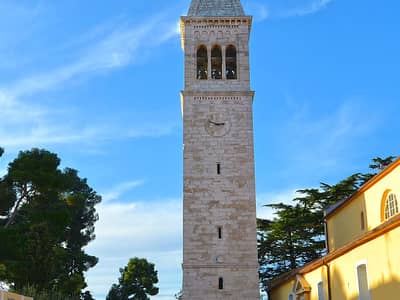
Bell tower (Novigrad, Istria)
The freestanding bell tower next to the parish church of St. Pelagius and St. Maximilian was built in 1883 and patterned after the bell tower of St. Mark"s in Venice. On the tower’s pyramidal spire dominates the statue of St. Pelagius, the city’s patron saint, who was placed there in 1913. The statue is made of wood and covered with a bronze metal sheet. During the summer months, visitors can climb to the top of the bell tower from which there is a beautiful view of the Novigrad’s Riviera. Bell tower Info
Church of St. Pelagius and St. Maximilian (Novigrad, Istria)
The parish church of St. Pelagius and St. Maximilian (a cathedral until 1828) is a basilica with three naves, which received its original form in the Early Christianity. Traces of earlier periods are visible along the northern longitudinal wall, where Early Christian window frames were discovered in 1972. The interior of the church is dominated by a Baroque altar and a raised, deep choir, under which an (Early) Romanesque crypt is located, unique of its kind in Istria and one of few in Croatia. Church of St. Pelagius and St. Maximilian info
Belvedere Novigrad
Originally it had a hipped roof. To the West of the Loggia, the vaulted passage Porta a marina leads to the sea. The keystone of the arch bears the date 1649, but the entire construction was moved to this place from its original location in the north-western part of the city at the time of the establishment of the new city park in the 19th century.
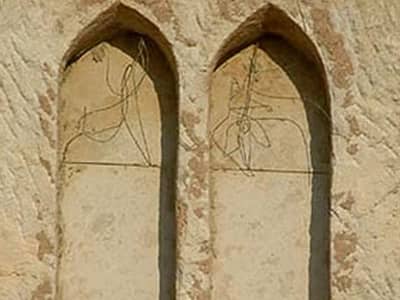
Bifora
As the plaster was removed from the front of a building at Trg Pozzetto in 1994.
A Late Gothic biforium (double-arched window) was discovered, reused as spolia and stemming presumably from one of the medieval churches that once existed within the Novigrad city walls.
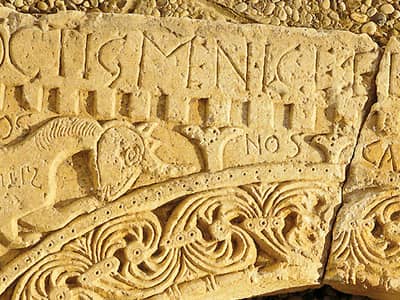
Ciborij biskupa Mauricija
The hexagonal ciborium (vaulted altar canopy) stood in the baptistery next to the Novigrad cathedral. Its ancient appearance was recreated in a drawing by L. Dufourny (1754-1818), who had found it in a dilapidated condition (thus the reconstruction of the fragmentary ciborium is not entirely univocal).
The inscription along its arches refers to Bishop Mauritius, who commissioned the ciborium. As Istrian bishop, Mauritius is mentioned in a letter by Pope Adrian I to Charlemagne (dated to between 776 and 780), which also sheds light on the time of origin of the ciborium. The composition and the choice of motifs in the relief decorations are characteristic of ciboria in general, but above all of those in the Veneto and Friuli regions. The Mauritius Ciborium, without equal in Istria, was presumably produced in a workshop in Cividale, and represents the last echo of the “Liutprand Renaissance”, the Lombard art at the new Carolingian court.
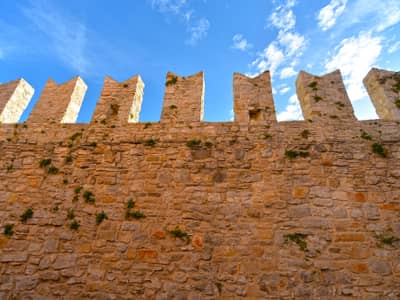
City walls Novigrad
They were the work of local master builders, which, in lengthy and persistent labour, at first constructed low defensive fortifications, and later, in their traditional manner, erected high walls with the characteristic battlements, made of cut quarrystone. The walls were renewed repeatedly. An older square tower stands next to the former city gate, while the round towers stem from the Renaissance. The latest restoration works on wall fragments lining Prolaz Venecija and the seashore side of the Brolo Park were carried out in 2004/05.
Kripta
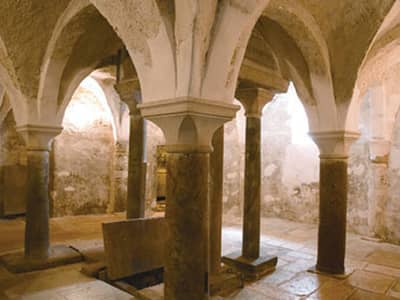
Behind the high altar of the St. Pelagius' Church lies a sunken (Early) Romanesque crypt, the only of its kind in Istria, and one of only a few in Croatia. The crypt has three naves, with strong cross vaults and two small, vaulted spaces in the dead corners. In the central part, the confessio (chamber with holy tomb) is located, bearing an inscription with the name of Bishop Adam from the year 1146.
During the archaeological excavations carried out in 1895, aiming to determine the foundations of the Early Christian basilica, numerous fragments of liturgical inventory from the (Early) Middle Ages were found in the crypt. Today, they are on display at the Lapidarium Museum in Novigrad. The museum’s stone collection was supplemented with further finds made during the renovation works of 1996-1999. These provided new information relevant to the dating of the origins of the crypt, the St. Pelagius’ Church and the city itself. Since, typologically, the Novigrad crypt bears a likeness to that of Aquileia, it is dated to between the end of the 8th and the beginning of the 9th century.
Ladanjska palača / Samostan u Dajli
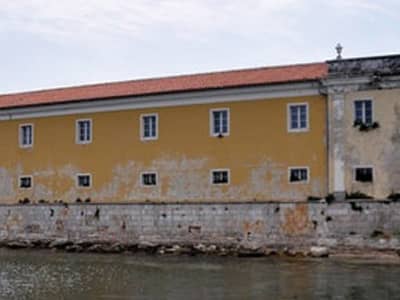
In Dajla, at the very seashore, lies a valuable architectural complex, whose harmonious beauty and long, eventful history attracts the attention of both specialists and casual passersby. The complex acquired its present appearance in 1839, after plans of French architect Le Terrier de Manetot.
To this origin of its architect the palace of Dajla ows its French Neoclassicist appearance, unique in Istria. At the place of an old, square building with towers at each of the corners, which was named the castrum from time immemorial, an elegant, rectangular two-storey house was erected, whose front was flanked with two nearly identical buildings. Having respected the style of the preceding period, De Manetot left the Baroque church of St. John the Baptist (consecrated in 1783), lying to the East of the villa, untouched, and constructed a new house of equal external appearance facing it (the residence of the chaplain).
This intentionally mirrored reflection strongly emphasizes the symmetry of the main building’s front, and leads through the (once cultivated) garden to the monumental portal that separates the building complex from the sea like a transparent membrane. A small pier shows that the villa could also be reached by the sea. The described architectural complex from the first half of the 19th century is one of only a few Neoclassicist cultural monuments on the Adriatic coast. Sadly, today the complex is uninhabited, disfigured by inappropriate building measures and dilapidated by age and human neglected. The oldest traces of its history stem from Antiquity, when a Roman estate was located at the same place. In the 5th and 6th century, Greek monks constructed a cloister there, which was taken over by the Benedictines in the 9th century. The cloister was consecrated to St. John the Baptist. In the mid- 13th century, it was abandoned and passed into the possession of the bishops of Novigrad. In the year 1273, Bishop Nicolò donated the cloister to the wealthy family Sabini from Koper, who renovated it. At this time, it received the name Kaštel Dajla (Castrum Dailae).
When the Sabini remained heirless, the castrum fell to the counts Grisoni from Koper. A reconstruction in the first half of the 19th century turned the Kaštel into a country villa. After a family tragedy, in 1835 Count Francesco Grisoni donated the villa to the Benedictines of St. Maria di Praglia (near Padua), under the condition that they dedicate themselves to the education of the local population. The Benedictines moved into the villa in 1860, and it once more became a cloister. It operated until 1948, when, in a political trial, the property was withdrawn from the Benedictines. Until 1989, the former cloister served as a home for the elderly and an almshouse, and since then it has been left to itself. The eventful and long history of the complex and its architectural value demand the conservation and/or restoration of this cloister-villa and its revitalization.
Lapidarium Novigrad
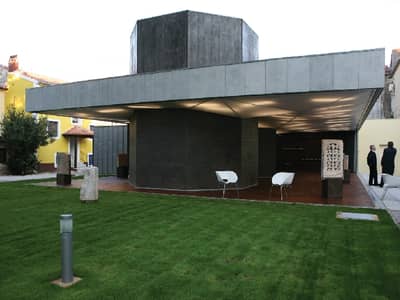
The museum collection comprises architectural elements (door sills, lintels, openwork window panels, coats of arms, etc.) and to a large degree liturgical inventory (altar plates, ciboria fragments, pilasters, capitals, etc.), originating from between the 1st and the 18th century. The most significant holdings of the Novigrad Lapidarium Museum belong to the collection from the Early Middle Ages, including the well-preserved Mauritius Ciborium from the end of the 8th century, a rare example of Early Carolingian art in the region. Between 1964 and 1993, the collection was housed on the ground floor of the Rigo Palace. From 1994 to 1998, it was in storage, and during this time the exhibits were conserved and restored. Today, the valuable collection is housed in the Lapidarium Museum, where its most outstanding pieces are on permanent display. The museum building was designed by the Randiæ- Turato architectural office from Rijeka and constructed in 20032006. Representing a successful combination of the old and the new, with its modern concept the building not only provides a suitable frame for the exhibits, but also contributes to the revitalization of the city centre.
Patricijska palača Rigo
The Rigo family belonged to the original nobility of Novigrad (having carried the comital title since 1743). For centuries its members held the most important public offices in the city. One of the many guests at the family's country estate on the Karpinjan peninsula was the renowned travel writer A. Fortis.
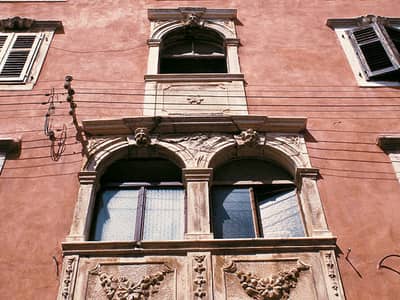
Contrary to the settler nobility of modern times, the counts Rigo did not neglect the dying city of their origin. As authentic representatives of the city nobility, in 1770 they financed the building of a new, representative town palace. This building is a fine example of “Central European Baroque”, which reached the Istrian coastland via the “Theresian” Trieste. The façade of this enclosed architectural cube is structured with harmonious decorative elements that were not usual for Istrian palaces of the time. Since the restoration of the façade in 1994, the ground floor houses a modern and contemporary art gallery named after the Rigo family. According to historical records, Count Carl Rigo, who commissioned the construction of the family’s country mansion on the Karpinjan peninsula, was the son of Venetian poet and painter Maria Giovanna Marcello.
Sipar
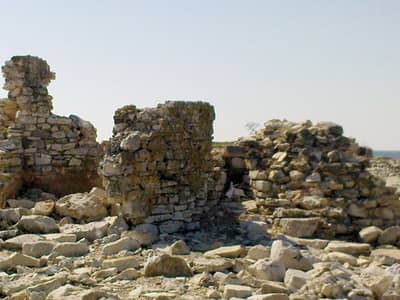
The Tabula Peutingeriana, the most ancient geographical map, mentions the settlement by the name of Sepomaia. In 876 it was attacked and destroyed by Prince Domagoj. The castle of Sipar was still inhabited in the years after 1552, when it was bought by the Rotas from Momjan. It previously belonged to the Bratti brothers from Koper, and before that to the bishop of Triest.
Little remains nowadays of the old buildings and the gate. The land extension stretching into the sea has become gradually thinned to its present state, due to slow seismic changes. The phenomenon is responsible for the fact that the western coast of Istria sinks about one millimetre a year, that is two metres in 2000 years. This stretch of coast has been a naturist resort for many years now.
Stancija grofova Rigo
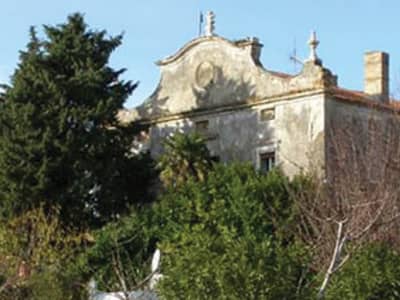
The (Late) Baroque building complex, erected in 1750, is located in Karpinjan, one kilometre north-west of Novigrad. The country mansion was commissioned by Carlo Rigo, a Novigrad nobleman who left deep and lasting traces in the city's cultural life. Originally, the complex consisted of the central living quarters, a water reservoir in front of it and stables to both sides, as well as a walled-in canopied patio.
Continuing the original architectural idea, between the two World Wars a modern concrete barn with silos was built at the northern end of the yard, as was common practice in the region, owing to the intensive cultivation of land during the Italian Fascist rule. The central building and one of the two stables with a hayloft have remained intact until the present, while the second stable building was adapted into a residence some decades ago. The Rigo mansion is a peripheral, pronouncedly consistent and comparatively well preserved example of an architectural style that was cultivated in Koper and Piran under considerable influence of Venice. Certainly, the buildings are in a poor state of repair today, but it is precisely for this reason, that a series of structures and interior decorations may be seen preserved practically in their original state.
10
Karpinjan
Laguna
Maestral
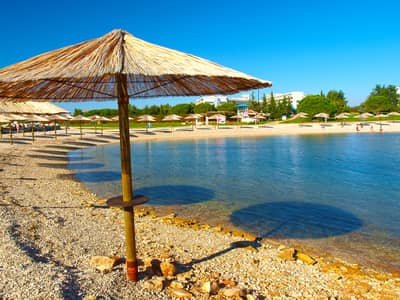
Mareda
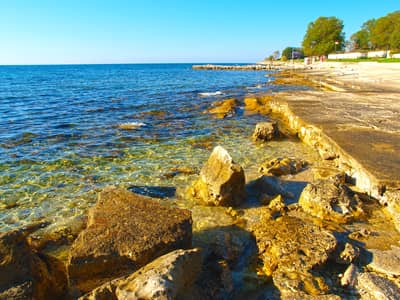
Sirena
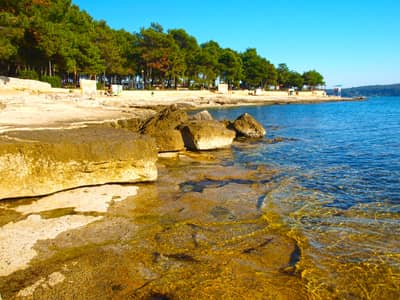
Town beach Novigrad
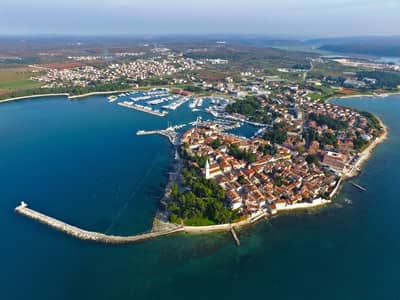
06
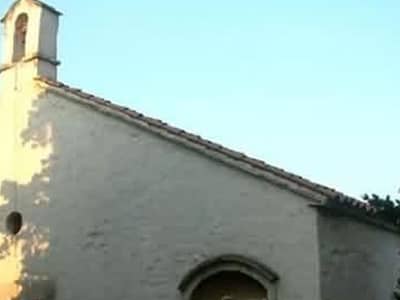
Crkva Sv. Agate
St. Agatha's Church lies at the old city cemetery. With its trefoil apse, it is an example of Romanesque sacral architecture. Its construction with three naves, a saddle roof and a specific sanctuary that extends through the choir of the central apse, make it especially interesting.
The church is dated to the period between the 9th and the 13th century. In addition to Carolingian influences, it also bears features typical of the regional sacral architecture of the Middle Ages. Its interior harbours two Late Baroque sculptures of local origin (light-bearing angels) and an altar depiction of St. Agatha. The church was restored and conserved in 1993 – 1995.
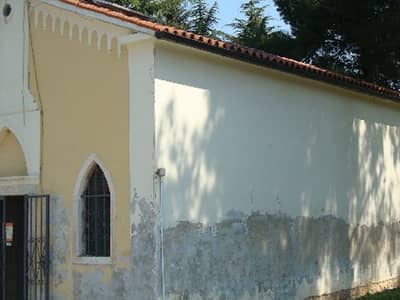
Crkva Sv. Antona
This church with one nave was built in the Gothic period and was renewed in the 17th century. In the mid-19th century, its sanctuary was enlarged and two side windows were added.
It is the only of the once numerous medieval village churches in the environs of Novigrad, that is preserved today.
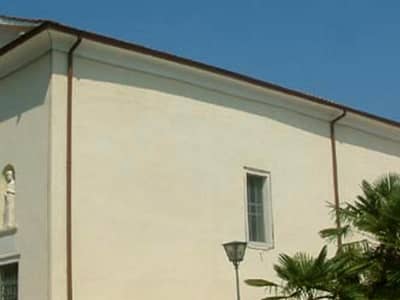
Župna crkva
The church was built not far from the harbour, on a slightly elevated spot, perhaps to comfort those who are leaving and welcome those who have come back. The original structure, dated to the 11th century, was rebuilt in 1826. On that occasion the architectonic organization was radically modified, in so far as the two aisles were demolished, while only the nave went through the process of rebuilding.
We can suppose that the original aspect of the shrine has been preserved in the upper left corner of Tintoretto’s fresco. The fact that there used to be two aisles, making the church more capacious, certainly testifies to the importance attached to it in the past. Once there was an inscription on the facade, in memory of the indulgence conceded by Pope Alexander III on the occasion of the famous naval battle. The slab was removed in the late 18th century. The general indulgence was renewed through the papal bull issued by Pope Pius II in 1459. To the right of the entrance. under the window, an inscription was placed in 1877 on the occasion of the 700th anniversary of the battle. Besides regular priesthood, to pursue pastoral activities in the area were also Franciscan Third Order Regulars from Dalmatia (after 1469), and later Augustinians. The parish was established at an unknown time. There used to be a cemetery attached to the church. The rose window on the front side was made in 1946, along with the indoor pulpit and the triumphal arch of the presbitery. It was in the same year that Francesco Miloš from Triban adorned the church with frescos. The nave contains an image of Jesus handing the keys to St Peter, against a background showing the church and the parish priest’s office at Savudrija. Watching from the triumphal arch above are St Francis of Assisi and St Joseph, while the ceiling of the presbitery was adorned with Jesus, St John and St Peter at the Last Supper. The parapet of the organ shows St Cecilia. In 1984 there was another restoration. Of the three altars in the church, in the main one the Virgin Mary is flanked by St John and St Peter, while the lateral altars contain statues of the Immaculate Madonna and the Most Sacred Heart of Jesus respectively (the latter from 1935). Besides, the parish church enshrines five paintings belonging to the school of Venice. They show St Lucy, St Agatha, pieta, St John’s martyrdom, and Jesus on the Cross surrounded with saints. Attached to the building is the 20-metre high steeple from 1869. It used to have three bells, but in 1943 two were requisitioned and never returned. One of them was about 20 years old, while the other was cast by the Eredi De Polis from Venice in 1754. The bell that was left on the steeple, made in 1935, was recast in 1983. On the nearby parish priest’s office and its belonging well one can see two coats of arms from 1476, indicating Hieronimus Donato, podesta of Piran.
Župna crkva Sv. Pelagija i sv. Maksima
The present parish church (a cathedral until 1828) is a basilica with three naves, that originates, according to two different theories, either from Early Christianity or from the second half of the 8th century. Traces of these older periods are visible along the northern longitudinal wall, where Early Christian window frames were discovered in 1972.
The sacral complex also incorporated a baptistery and an episcopal palace, which were torn down in the second half of the 19th century. The old bell tower that was leaning against the cathedral front was replaced by a new, free-standing campanile in 1874. The church building was thoroughly renewed in the years 1408, 1580, 1746 and 1775. In the Middle Ages, its interior was painted with frescoes, as fragments at the southern side altar show. The present, Neoclassicist façade was finalized in 1935. The interior of the church is dominated by a Baroque altar and a raised, deep choir, under which an (Early) Romanesque crypt is located.
04

Více o Novigradu
zjistit více
Novigrad
Novigrad proslavilo množství památek, které dokládají bohatou historii tohoto města. Nenechte si ujít zdejší kolekci 93 kamenných předmětů z dob antiky a a novověku, kostel sv. Pelagia a sv. Maksima (bazilika si zachovala původní podobu z křesťanské éry, kdy byla novigradská diecéze vybudovaná), palác Rigo (barokní dům patricijské rodiny Rigů postavený v roce 1760), Belvedere ze 16. století, městské hradby ze 13. století, románský kostel sv. Agáty z 9. století, zámek Dajla (venkovská vila – klášter) a mnoho dalších historických památek. Novigrad je také místem, kde se v letním období konají nejrůznější slavnosti. Mezi ty nejznámější patří: Kulturní léto Novigrad (zábava a kultura, termín 10.06. – 31.08.), Gnam Gnam festival (gastronomický festival, který se koná 9. července), Novigradské hudební noci (14. – 15.07.), Rybářská noc a oslava sv. Pelagia (26.08. – 28.08.).
Během pobytu v Novigradu máte ideální příležitost prozkoumat také jeho okolí: malé ostrůvky, historická města a nedaleký přírodní park. Milovníci sportu a aktivní dovolené si zde mohou zahrát nohejbal, basketbal, tenis a plážový volejbal. Oblast je skvělá i pro projížďky na kole a samozřejmě různé vodní sporty.